
DIN934 Hex Nuts
A reliable nut is an essential part of a bolted connection, and DIN 934 Hex Nuts are designed for straightforward assembly with matching metric bolts and threaded components. Their six-sided body provides convenient access for tightening with a standard wrench or socket, while the internal metric thread creates the connection with the mating bolt. DIN 934 nuts are widely used where simple, removable fastening is required. They can be combined with washers and matching bolts to assemble components, brackets, machinery parts, frames, equipment, and fabricated structures. The standard hexagonal shape also makes them easy to install in production environments where conventional tools are used.
For different operating conditions, we can supply DIN 934 nuts in stainless steel, carbon steel, and alloy steel, with options for different strength requirements and surface finishes. Stainless steel is suitable for corrosion-sensitive environments, while carbon and alloy steel versions can be selected when mechanical performance and cost efficiency are key considerations. When selecting a DIN 934 nut, the thread size, thread compatibility, material, strength requirement, and surface treatment should be considered together with the mating bolt. For applications requiring additional resistance to loosening, a suitable locking nut or other locking method may be more appropriate than a standard DIN 934 nut.


Specification:
DIN 934 Hex Nuts are specified by their thread size, across-flats dimension, nut height, thread tolerance, material, property class, and surface finish. The traditional DIN 934 designation corresponds to the current ISO 4032 standard for regular hexagon nuts (style 1). For carbon and alloy steel nuts, mechanical and proof-load requirements are specified according to ISO 898-2, while stainless steel nuts can be specified according to ISO 3506-2.
For standard production, we can supply DIN 934 nuts in carbon steel, alloy steel, and stainless steel, with different property classes, stainless-steel grades, and surface finishes according to the requirements of the complete bolted assembly. Thread dimensions and tolerances should be selected together with the matching bolt, stud, or threaded component to ensure proper engagement.
| Item | Specification |
|---|---|
| Standard | DIN934 |
| Product Type | Hex Nut/Hexagon Regular Nut |
| Thread | Metric Coarse |
| Thread Standard | ISO965 |
| Size Range | M1-M160 |
| Steel Property Class | 5,6,8,10,12 |
| Steel Mechanical Standard | ISO898-2 |
| Stainless Steel Property Class | A2-70/80,A4-70/80 |
| Stainless Steel Mechanical Standard | ISO3506-2 |
| Surface treatment | Zinc Plated,Black Oxidation,HDG,Dacromet,Bright Finish,Passivation |
| Inspection | Dimensions,Thread,Proof Load,Hardness,Coating |
Dimension Chart of DIN934 Hex Nuts:
The DIN 934 dimension chart helps you select the correct nut by comparing thread size, across-flats width, nut height, and thread specifications. These dimensions should be checked against the matching bolt or stud to ensure proper thread engagement and wrench access during assembly.
For common metric assemblies, the nut size is normally selected according to the bolt diameter, while the available space around the fastener determines whether the standard across-flats dimension is suitable. For large or non-standard requirements, we can also manufacture nuts according to customer drawings, specified dimensions, or assembly requirements. When ordering DIN 934 nuts, it is important to confirm not only the nominal thread size but also the thread pitch, tolerance, material/property class, and surface treatment, particularly when the nuts are being matched with coated or high-strength bolts.
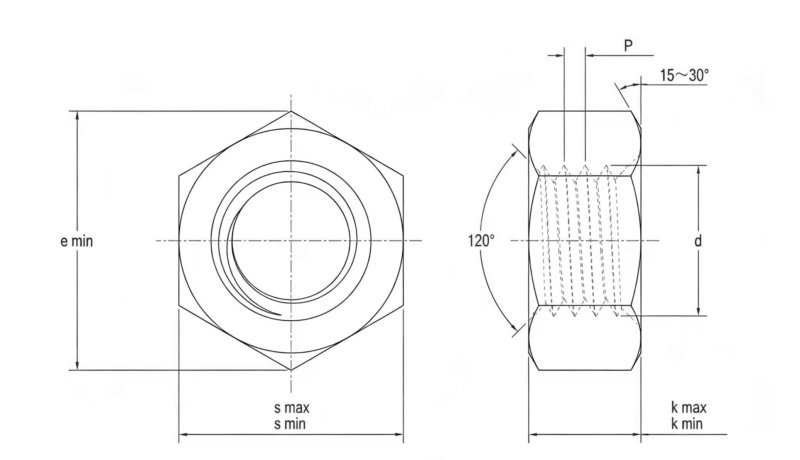
| Mon | M1 | M1.2 | M1.4 | M1.6 | M2 | M2.5 | M3 | M3.5 | M4 | M5 | M6 | M7 | M8 | M10 | M12 | M14 | M16 | M18 |
| P | 0.25 | 0.25 | 0.3 | 0.35 | 0.4 | 0.45 | 0.5 | 0.6 | 0.7 | 0.8 | 1 | 1 | 1|1.25 | 1|1.25|1.5 | 1.25|1.5|1.75 | 1.5|2 | 1.5|2 | 1.5|2|2.5 |
| e min | 2.71 | 3.28 | 3.28 | 3.41 | 4.32 | 5.45 | 6.01 | 6.58 | 7.66 | 8.79 | 11.05 | 12.12 | 14.38 | 18.9 | 21.1 | 24.49 | 26.75 | 29.56 |
| k max | 0.8 | 1 | 1.2 | 1.3 | 1.6 | 2 | 2.4 | 2.8 | 3.2 | 4 | 5 | 5.5 | 6.5 | 8 | 10 | 11 | 13 | 15 |
| k min | 0.55 | 0.75 | 0.95 | 1.05 | 1.35 | 1.75 | 2.15 | 2.55 | 2.9 | 3.7 | 4.7 | 5.2 | 6.14 | 7.64 | 9.64 | 10.3 | 12.3 | 14.3 |
| s max | 2.5 | 3 | 3 | 3.2 | 4 | 5 | 5.5 | 6 | 7 | 8 | 10 | 11 | 13 | 17 | 19 | 22 | 24 | 27 |
| s min | 2.4 | 2.9 | 2.9 | 3.02 | 3.82 | 4.82 | 5.32 | 5.82 | 6.78 | 7.78 | 9.78 | 10.73 | 12.73 | 16.73 | 18.67 | 21.67 | 23.67 | 26.16 |
| Mon | M20 | M22 | M24 | M27 | M30 | M33 | M36 | M39 | M42 | M45 | M48 | M52 | M56 | M60 | M64 | M68 | M72 | M80 |
| P | 1.5|2|2.5 | 1.5|2|2.5 | 2|3 | 2|3 | 2|3.5 | 2|3.5 | 3|4 | 3|4 | 3|4.5 | 3|4.5 | 3|5 | 3|5 | 4|5.5 | 4|5.5 | 4|6 | 4|6 | 4|6 | 4|6 |
| e min | 32.95 | 35.03 | 39.55 | 45.2 | 50.85 | 55.37 | 60.79 | 66.44 | 71.3 | 76.95 | 82.6 | 88.25 | 93.56 | 99.21 | 104.86 | 110.51 | 116.16 | 127.46 |
| k max | 16 | 18 | 19 | 22 | 24 | 26 | 29 | 31 | 34 | 36 | 38 | 42 | 45 | 48 | 51 | 54 | 58 | 64 |
| k min | 14.9 | 16.9 | 17.7 | 20.7 | 22.7 | 24.7 | 27.4 | 29.4 | 32.4 | 34.4 | 36.4 | 40.4 | 43.4 | 46.4 | 49.1 | 52.1 | 56.1 | 62.1 |
| s max | 30 | 32 | 36 | 41 | 46 | 50 | 55 | 60 | 65 | 70 | 75 | 80 | 85 | 90 | 95 | 100 | 105 | 115 |
| s min | 29.16 | 31 | 35 | 40 | 45 | 49 | 53.8 | 58.8 | 63.1 | 68.1 | 73.1 | 78.1 | 82.8 | 87.8 | 92.8 | 97.8 | 102.8 | 112.8 |
Application of DIN934 Hex Nut:
Machinery & Industrial Equipment
DIN 934 Hex Nuts are commonly used in machine frames, brackets, guards, conveyor equipment, pumps, motors, and general industrial machinery where components need to be securely fastened but remain removable for installation or servicing.
Structural & Fabricated Assemblies
They are suitable for steel structures, fabricated frames, support brackets, platforms, equipment bases, and general metal assemblies where standard metric bolts and nuts are used to create bolted joints. Carbon and alloy steel versions can be selected according to the required mechanical performance and service environment.
Stainless Steel Equipment
A2 and A4 stainless steel DIN 934 nuts are suitable for equipment exposed to moisture, outdoor conditions, chemicals, or corrosive environments. Typical applications include food-processing equipment, stainless steel fabrication, water-treatment equipment, pumps, marine-related equipment, and outdoor machinery.
Selection Note
DIN 934 is a standard non-locking hex nut. Where vibration or repeated movement may cause loosening, the assembly may require a suitable locking method such as a prevailing-torque nut, washer system, thread-locking compound, or mechanical locking feature.