
A563 Heavy Hex Nuts
ASTM A563 Heavy Hex Nuts are heavy-pattern hexagonal nuts designed for use with carbon steel and alloy steel bolts in demanding mechanical and structural fastening applications. Compared with standard hex nuts, the heavy hex configuration provides a larger wrenching profile and a more substantial bearing surface, making it suitable for bolted joints where the nut must work together with the mating fastener to develop the required clamping force.
The A563 specification covers different nut grades for different mechanical requirements. For our regular supply range, Grade A, Grade C, and Grade DH provide options from general-purpose carbon steel fastening to higher-strength structural connections. Grade A is suitable for conventional mechanical and structural assemblies, while Grade C is selected where higher strength is required. Grade DH is intended for high-strength bolting applications and is commonly specified with structural fastener systems.


Specification
ASTM A563 Heavy Hex Nuts are specified as heavy-pattern hexagonal nuts for inch-series bolted connections. The standard establishes requirements for the nut’s dimensions, material, chemical composition, mechanical properties, and related manufacturing requirements, while different grades are used to meet different levels of mechanical performance. For our regular supply range, we focus on Grade A, Grade C, and Grade DH.
The basic product specification starts with the nominal thread size and nut dimensions, including the width across flats, nut thickness, and thread configuration. The selected grade then determines the applicable mechanical requirements. Grade A, Grade C, and Grade DH should not be treated as interchangeable simply because they share the same basic heavy hex geometry; the appropriate grade should be selected according to the mechanical requirements of the mating bolt and the complete fastening assembly.
Item Specification Standard ASTM A563/A563M Product Type Heavy Hex Nut Size Sysstem Inch Dimensions ASME B18.2.2 Heavy Hex Nut Thread Diameter 1/4"-4" Thread Type UNC/UNF/8UN Materials C45 Medium Carbon Steel Mechanical Grade A/C/DH Surface treatment Black Oxide Coating/Zinc Plating/Hot Dip Galvanized Mating Fasteners A307 Heavy Hex Bolt, A325 Heavy Bolt, F436 Flat Washer
Chemical Requirements:
| Grade | Carbon% | Manganese%, min | Phosphorus%, max | Sulfur%, max |
|---|---|---|---|---|
| A, C | 0.58 max | - | 0.13 | 0.15 |
| DH | 0.18-0.58 | 0.57 | 0.048 | 0.058 |
Mechanical properties:
| Grade of A563 Nuts | Nominal Nut Size | Style of Nut | Proof Load Stress, ksi | Hardness (Brinell) | |
| Plain | Galvanized | ||||
| A | Hex | 1/4 - 1-1/2 | 90 | 68 | 116 - 302 |
| Heavy Hex | 1/4 - 4 | 100 | 75 | 116 - 302 | |
| C | Heavy Hex | 1/4 - 4 | 144 | 144 | 143 - 352 |
| DH | Heavy Hex | 1/4 - 4 | 175 | 150 | 248 - 352 |
Grade A
ASTM A563 Grade A Heavy Hex Nuts are intended for general-purpose applications where a heavy hex configuration is required without the higher proof-load requirement of the stronger A563 grades. Grade A and Grade C share the same basic chemical composition requirements under the specification, so the distinction between these two grades is not simply a change in steel chemistry. For Grade A, the specified proof load is 100 ksi, providing a suitable level of mechanical performance for conventional bolted assemblies.
The heavy hex profile provides a larger wrenching surface than a standard hex nut, making Grade A suitable for general steel fabrication, equipment supports, brackets, machinery assemblies, and other mechanically fastened connections. Where the design calls for a higher proof-load requirement, Grade C or Grade DH should be selected instead of treating Grade A as a universal substitute.
Grade C
ASTM A563 Grade C Heavy Hex Nuts use the same basic chemical composition requirements as Grade A, but are distinguished by a substantially higher mechanical requirement. With a specified proof load of 141 ksi, Grade C provides a higher load-carrying capability at the nut level and is intended for fastening applications where the mechanical requirements exceed those appropriate for Grade A.
This makes Grade C a useful choice for more heavily loaded mechanical assemblies, fabricated steel structures, equipment supports, and demanding bolted joints where a heavy hex nut is required but the application does not call for the higher 175 ksi proof-load level of Grade DH. The grade should be selected together with the mechanical requirements of the mating bolt and the designed connection.
Grade DH
ASTM A563 Grade DH Heavy Hex Nuts represent the high-strength end of the three grades covered on this page. Unlike the 100 ksi Grade A and 141 ksi Grade C, Grade DH has a specified proof load of 175 ksi, making it suitable for high-strength bolting systems where the nut must withstand substantially greater test loading.
Grade DH is particularly relevant to high-strength structural bolting and heavily loaded steel connections, where the nut is specified as part of a matched bolt, nut, and washer assembly. Applications can include structural steel frames, bridge components, heavy industrial structures, and other engineered connections requiring high-strength fastening. The mating bolt grade and the applicable structural fastening specification should be verified before selecting the nut.
Dimension Chart of A563 Heavy Hex Nuts:
The ASTM A563 Heavy Hex Nut dimension chart provides the measurements needed to select a nut that matches the inch-series bolt and the available installation space. Although Grade A, Grade C, and Grade DH have different mechanical requirements, the dimensional selection starts with the nominal thread size and the corresponding heavy hex nut dimensions.
The main dimensions include the nominal thread diameter, width across flats, width across corners, and nut thickness. The nominal size identifies the mating bolt, while the width across flats determines the required wrench or socket size. Nut thickness affects the available threaded engagement, and the width across corners is useful when checking clearance around the nut in brackets, connection plates, and other confined areas.
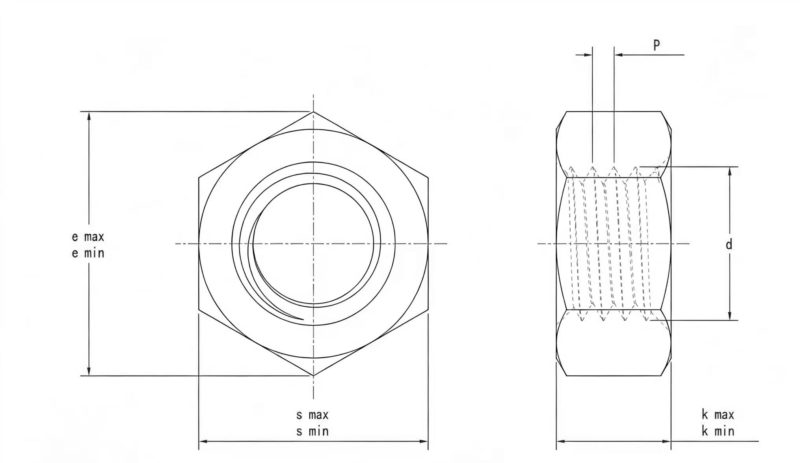
| Mon | 1/4 | 5/16 | 3/8 | 1/2 | 5/8 | 3/4 | 7/8 | 1 | 1-1/8 | 1-1/4 | 1-3/8 | 1-1/2 | 1-5/8 | 1-3/4 | 1-7/8 | 2 | 2-1/4 | 2-1/2 | 2-3/4 | 3 | 3-1/4 | 3-1/2 | 4 |
| P | 20|28|32 | 18|24|32 | 16|24|32 | 13|20|28 | 11|18|24 | 10|16|20 | 9|14|20 | 8|12|20 | 7|12|18 | 7|12|18 | 6|12|18 | 6|12|18 | 6|12|18 | 5|8|12 | 6 | 4.5 | 4.5 | 4 | 4 | 4 | 4 | 4 | 4 |
| s min | 0.448 | 0.546 | 0.669 | 0.85 | 1.031 | 1.212 | 1.394 | 1.575 | 1.756 | 1.938 | 2.119 | 2.3 | 2.481 | 2.662 | 2.844 | 3.025 | 3.388 | 3.75 | 4.112 | 4.475 | 4.838 | 5.2 | 5.925 |
| s max | 0.5 | 0.562 | 0.688 | 0.875 | 1.062 | 1.25 | 1.438 | 1.625 | 1.812 | 2 | 2.188 | 2.375 | 2.562 | 2.75 | 2.938 | 3.125 | 3.5 | 3.875 | 4.25 | 4.625 | 5 | 5.375 | 6.125 |
| e min | 0.556 | 0.622 | 0.763 | 0.969 | 1.175 | 1.382 | 1.589 | 1.796 | 2.002 | 2.209 | 2.416 | 2.622 | 2.828 | 3.035 | 3.242 | 3.449 | 3.862 | 4.275 | 4.688 | 5.102 | 5.515 | 5.928 | 6.755 |
| e max | 0.577 | 0.65 | 0.794 | 1.01 | 1.227 | 1.443 | 1.66 | 1.876 | 2.093 | 2.309 | 2.526 | 2.742 | 2.959 | 3.175 | 3.392 | 3.608 | 4.041 | 4.474 | 4.907 | 5.34 | 5.774 | 6.207 | 7.073 |
| k min | 0.218 | 0.28 | 0.341 | 0.464 | 0.587 | 0.71 | 0.833 | 0.956 | 1.079 | 1.187 | 1.31 | 1.433 | 1.556 | 1.679 | 1.802 | 1.925 | 2.155 | 2.401 | 2.647 | 2.893 | 3.124 | 3.37 | 3.862 |
| k max | 0.25 | 0.314 | 0.377 | 0.504 | 0.631 | 0.758 | 0.885 | 1.012 | 1.138 | 1.251 | 1.378 | 1.505 | 1.632 | 1.759 | 1.886 | 2.013 | 2.251 | 2.505 | 2.759 | 3.013 | 3.252 | 3.506 | 4.014 |
Application of A563 Heavy Hex Nuts:
ASTM A563 Heavy Hex Nuts are used where the nut needs to form part of a reliable inch-series bolted connection, with the appropriate grade selected according to the mechanical requirements of the joint. The heavy hex configuration is particularly suited to larger bolted assemblies where a substantial wrenching surface is required for tightening.
General Steel Fabrication — Grade A
Grade A can be selected for general-purpose bolted connections where a 100 ksi proof-load requirement is appropriate. Typical applications include fabricated steel frames, equipment bases, support brackets, machine guards, storage structures, and general steel assemblies. It is a practical option when the joint does not require the higher mechanical requirements of Grade C or Grade DH.
More Heavily Loaded Assemblies — Grade C
Grade C, with its higher proof-load requirement, can be considered for bolted joints subjected to greater mechanical demands than conventional Grade A applications. It can be used in heavy equipment supports, industrial steel assemblies, structural brackets, fabricated machinery frames, and load-bearing connection points where the specified fastening system calls for a higher-strength nut.
High-Strength Structural Bolting — Grade DH
Grade DH is the key choice among the three grades for high-strength fastening applications, with a specified proof load of 175 ksi. It is used with compatible high-strength structural bolts in applications such as steel building frames, bridge components, structural connection plates, heavy support structures, and engineered steelwork where the fastening system requires a high-strength nut.