
DIN985 Nylon Lock Nuts
DIN 985 Nylon Lock Nuts are designed to provide a secure threaded connection where resistance to loosening is important. Featuring a hexagonal body and an integrated nylon insert, the nut creates additional resistance against the mating thread during installation, helping reduce loosening caused by vibration and repeated movement.
Available in carbon steel, alloy steel, and stainless steel, DIN 985 Nylon Lock Nuts can be selected according to the required mechanical strength and service environment. Steel versions are suitable for general mechanical and structural fastening, while stainless steel options such as 304 and 316 provide enhanced corrosion resistance for outdoor, humid, and demanding environments. Different strength grades and finishes can also be specified according to the application. These self-locking nuts are commonly used with compatible bolts and studs in machinery, equipment, automotive components, brackets, panels, and general mechanical assemblies. When selecting a DIN 985 Nylon Lock Nut, the nominal size, thread pitch, material, strength grade, nylon insert, and surface finish should be matched to the mating fastener and operating conditions.


Specification of DIN985:
DIN 985 Nylon Lock Nuts are specified according to their dimensional, mechanical, and functional requirements for reliable threaded connections. The nut dimensions and thread configuration follow the applicable DIN 985 requirements, while the mechanical properties of steel nuts are determined according to the selected property class and applicable fastener standards.
The integrated nylon insert provides a prevailing torque feature that creates resistance to rotation on the mating thread. The functional performance of the locking feature can be evaluated according to ISO 2320:2015, which specifies requirements and test methods for prevailing torque nuts with non-metallic inserts. The applicable prevailing-on and prevailing-off torque requirements depend on the nut size and property class. For product selection, the nominal size, thread pitch, property class, material, nylon insert, and surface finish should be considered together with the mating bolt or stud to ensure proper fit and locking performance.
| Item | Specification |
|---|---|
| Standard | DIN985 |
| Product Type | Nylon Insert Lock Nut |
| Nut Type | Prevailing Torque Type |
| Thread System | Metric |
| Thread Standard | ISO965-2 |
| Mechanical Property | ISO898-2 |
| Prevailing Torque | ISO2320 |
| Size Range | M3-M48 |
| Material | Carbon Steel,Alloy Steel,Stainless Steel |
| Surface Treatment | Zinc Plated,Bright Finish |
Chemical Composition:
| Property class | Carbon% | Manganese%, min | Phosphorus%, max | Sulfur%, max |
| 5,6 | 0.5 max | - | 0.11 | 0.15 |
| 8 | 0.58 max | 0.25 | 0.06 | 0.15 |
| 10 | 0.58 max | 0.3 | 0.048 | 0.058 |
Mechanical property:
| Thread Diameter | Property Class | |||||||
| 5 | 8 | 10 | 12 | |||||
| Proof Stress | Vickers Hardness HV | Proof Stress | Vickers Hardness HV | Proof Stress | Vickers Hardness HV | Proof Stress | Vickers Hardness HV | |
| Up to M4 | 520 | 130-302 | 800 | 170 | 1040 | 272-353 | 1150 | 295-353 |
| M4-M7 | 580 | 130-302 | 810 | 188 | 1040 | 272-353 | 1150 | 295-353 |
| M7-M10 | 590 | 130-302 | 830 | 1040 | 272-353 | 1160 | 295-353 | |
| M10-M16 | 610 | 130-302 | 840 | 1050 | 272-353 | 1190 | 295-353 | |
| M16-M39 | 630 | 146-302 | 920 | 233 | 1060 | 272-353 | 1200 | 295-353 |
- RELATED NUT LISTS:
- DIN6334 Hexagon Coupling Nuts
- ASME/ANSI B 18.2.2 Hex Slotted Nuts/Castle Nuts
- ASME/ANSI B18.2.2 Hex Flange Nuts
- Lock Nuts
- IFI145 Flange Nuts
- DIN982 Nylon Lock Nuts
- ASME B 18.16.6 Nylon Nuts
- HEX NUT
- JIS 1186 Hex Nuts
- DIN934 Hex Nuts
- A194 Hex Nuts
- A563 Hex Nuts
- DIN6915 Hex Nuts
- GOST 28919 Thick Hex Nuts
- GOST R 52645 Structural Hex Nuts
- GOST 5915 Hex Nut
- UNI5588 Hex Nuts
- UNI5587 Thick Hex Nuts
- UNI5713 Hex Nuts
- AS1112.1 Hex Nuts
- AS1252 Hex Nuts
- AS/NZS 2451 Hex Nuts
- AS/NZS 2465 Hex Nuts
- DIN6330 Hex Thick Nuts
- ASME/ANSI B 18.2.2 Hex Thick Nuts
Dimension Chart of DIN985 Nylon Nuts:
The dimension chart shows the key measurements used to identify and install DIN 985 Nylon Lock Nuts. Nominal thread size, nut width, nut height, and thread dimensions determine compatibility with the mating bolt or stud. The nylon insert is positioned within the upper section of the nut and forms the locking area, so the nut should be selected with the correct thread size and bolt engagement for the intended connection.
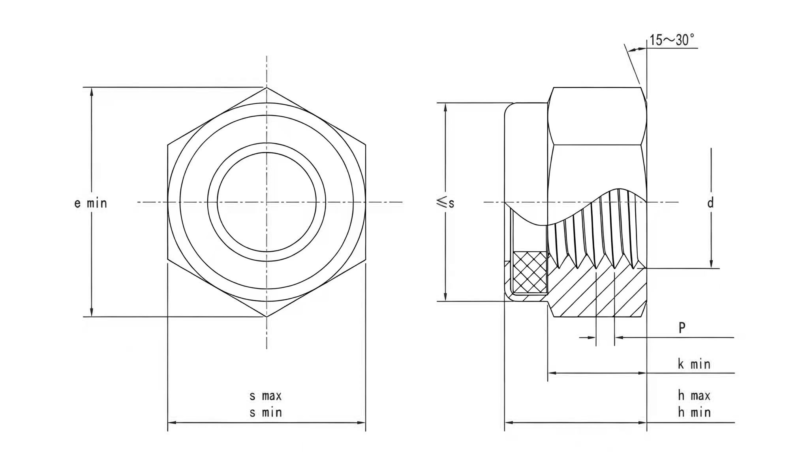
| Mon | M3 | M4 | M5 | M6 | M7 | M8 | M10 | M12 | M14 | M16 | M18 | M20 | M22 | M24 | M27 | M30 | M33 | M36 | M39 | M45 | M48 |
| P | 0.5 | 0.7 | 0.8 | 1 | 1 | 1|1.25 | 1|1.25|1.5 | 1.25|1.5|1.75 | 1.5|2 | 1.5|2 | 1.5|2|2.5 | 1.5|2|2.5 | 1.5|2|2.5 | 2|3 | 2|3 | 2|3.5 | 2|3.5 | 3|4 | 3|4 | 3|4.5 | 3|5 |
| e min | 6.01 | 7.66 | 8.79 | 11.05 | 12.12 | 14.38 | 18.9 | 21.1 | 24.49 | 26.75 | 29.56 | 32.95 | 35.03 | 39.55 | 45.2 | 50.85 | 55.37 | 60.79 | 66.44 | 76.95 | 82.6 |
| h max | 4 | 5 | 5 | 6 | 7.5 | 8 | 10 | 12 | 14 | 16 | 18.5 | 20 | 22 | 24 | 27 | 30 | 33 | 36 | 39 | 45 | 48 |
| h min | 3.7 | 4.7 | 4.7 | 5.7 | 7.14 | 7.64 | 9.64 | 11.57 | 13.3 | 15.3 | 17.66 | 18.7 | 20.7 | 22.7 | 25.7 | 28.7 | 31.4 | 34.4 | 37.4 | 43.4 | 46.4 |
| k min | 2.4 | 2.9 | 3.2 | 4 | 4.7 | 5.5 | 6.5 | 8 | 9.5 | 10.5 | 13 | 14 | 15 | 15 | 17 | 19 | 22 | 25 | 27 | 32 | 36 |
| s max | 5.5 | 7 | 8 | 10 | 11 | 13 | 17 | 19 | 22 | 24 | 27 | 30 | 32 | 36 | 41 | 46 | 50 | 55 | 60 | 70 | 75 |
| s min | 5.32 | 6.78 | 7.78 | 9.78 | 10.73 | 12.73 | 16.73 | 18.67 | 21.67 | 23.67 | 26.16 | 29.16 | 31 | 35 | 40 | 45 | 49 | 53.8 | 58.8 | 68.1 | 73.1 |
Application of DIN985 Nylon Nuts:
Machinery & Equipment
DIN 985 Nylon Lock Nuts are suitable for machine assemblies, equipment frames, brackets, guards, covers, and mechanical components where vibration or repeated movement may cause a conventional nut to loosen. The nylon insert provides additional resistance to rotation after the nut is installed.
Automotive & Mobile Components
The locking feature makes DIN 985 nuts useful for vehicle components, mounting brackets, mechanical linkages, chassis-related assemblies, and other applications subject to vibration or movement. They can be paired with compatible bolts and studs where a secure threaded connection is required.
Electrical, Panels & General Assemblies
These nuts are also suitable for electrical equipment, control cabinets, mounting panels, fabricated components, and general industrial assemblies where a compact self-locking nut can simplify the fastening arrangement. Stainless steel versions can be selected for applications where improved corrosion resistance is required.