
ISO4017 Hex Bolts
ISO 4017 specifies the dimensions, head structure and metric threads of metric coarse-threaded carbon steel, alloy steel and stainless steel hex head bolts. The mechanical properties are not individually stipulated by ISO 4017. Carbon steel and alloy steel products usually determine their performance grades according to ISO 898-1, while stainless steel products refer to ISO 3506-1. The threaded part is of full-thread structure. ISO 4017 hex bolts are commonly used in mechanical equipment, industrial assembly, metal structures and other connections that require a longer thread engagement length.
We have the capacity for mass production of ISO 4017 hex bolts, which can be produced stably according to different specifications, materials and performance grades. The monthly production capacity is approximately 1,000 tons. During the production process, the head size, length, threads and other key dimensions of the bolts are controlled in accordance with ISO 4017, and the mechanical properties are controlled according to the corresponding materials and property standards. Ningbo Teng Qi Fasteners Co., Ltd. has obtained ISO 9001 quality management system certification. Before shipment, the products undergo inspections for dimensions, threads and mechanical properties, etc., to ensure compliance with customer requirements. With its stable batch supply capability, our ISO 4017 hexagonal bolts have been exported to Europe, Saudi Arabia, United Arab Emirates, Australia and Korea.
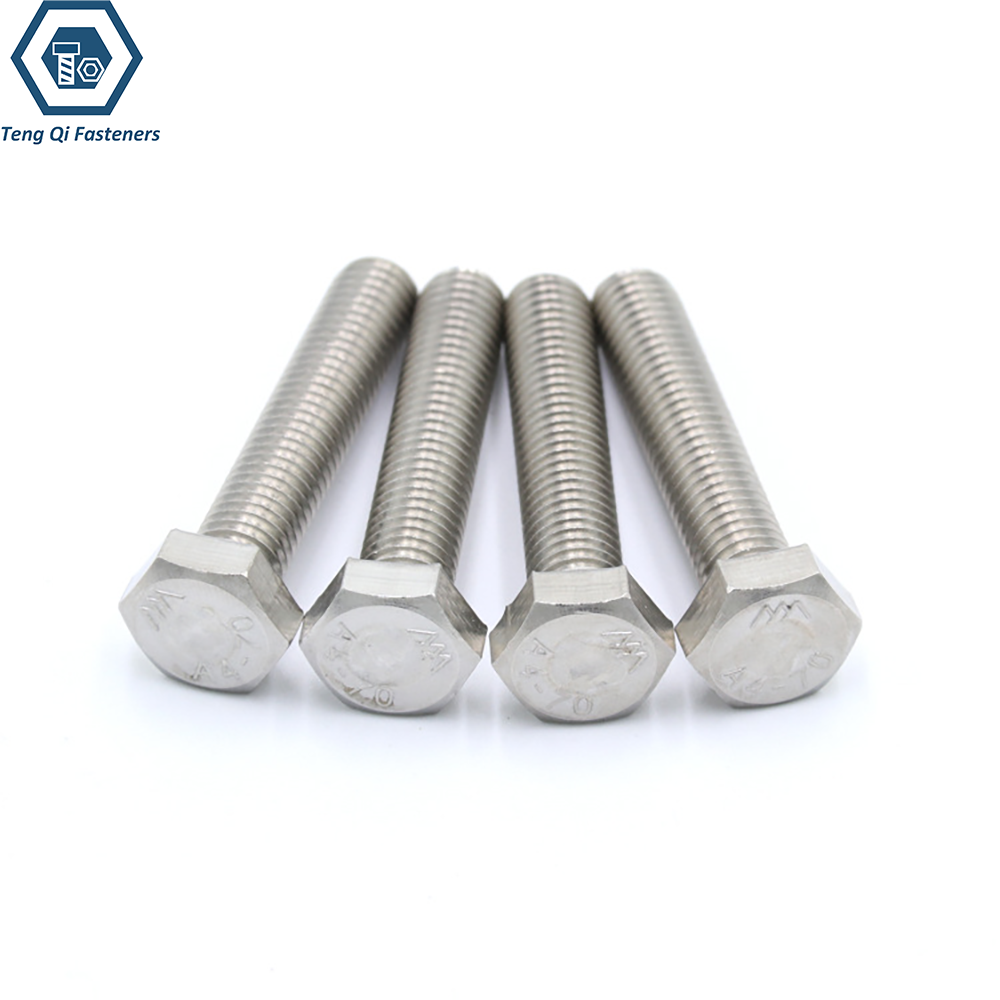
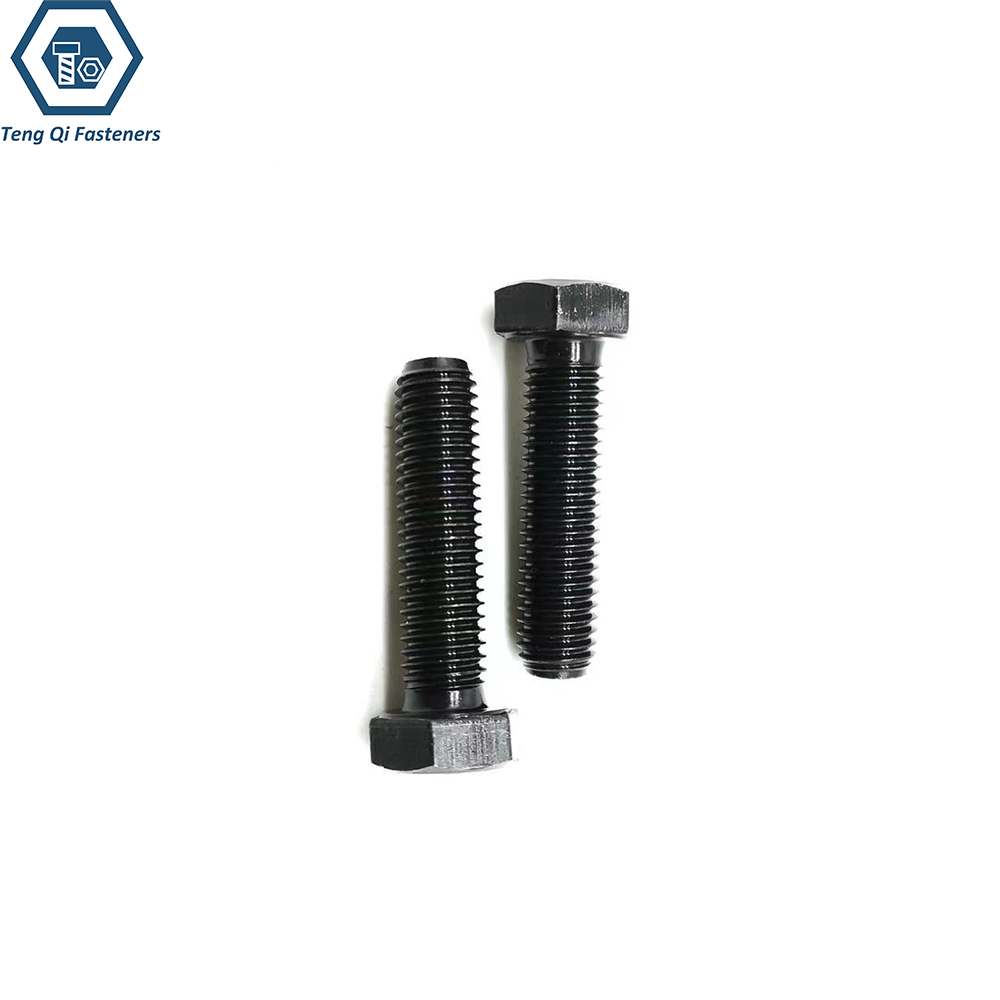
Specification:
| Item | Specification |
|---|---|
| Standard | ISO4017 |
| Product Type | Full Thread Hex Head Bolts |
| Size Range | M1.6-M64 |
| Thread Tolerance | ISO965-1 |
| Thread | Metric Coarse |
| Product Grade | A and B |
| Steel Proeperty Standard | ISO 898-1 |
| Steel Bolts Class | Class 4.8,8.8,10.9,12.9 |
| Stainless Steel Property Standard | ISO3506-1 |
| Stainless Steel Bolts Class | A2-50,A2-70,A2-80 A4-50,A4-70,A4-80 |
| Material | Carbon Steel, Alloy Steel, Stainless Steel |
| Surface treatment | Plain,Zinc Plated,Hot Dip Galvanized,Black Oxidation, Bright Finish, Passivation |
- RELATED BOLTS LISTS:
- HEX BOLTS
- DIN933 HEX BOLTS
- DIN 931 HEX BOLTS
- ISO 4014 HEX BOLTS
- ASME B 18.2.1 HEX BOLTS
- GOST 7798 HEX BOLTS
- HEAVY HEX BOLTS
- DIN 6914 STRUCTURAL BOLTS
- AS 1252 STRUCTURAL BOLTS
- ASME B 18.2.1 HEAVY HEX BOLTS
- ASME B 18.2.6 HEAVY HEX BOLTS
- JIS 1186 BOLTS
- EN 14399-3 BOLTS
- EN 14399-4 BOLTS
- STUD BOLTS
- DIN976 STUD BOLTS
- DIN939 STUD BOLTS
- ASME B 18.31.2 STUD BOLTS
- IFI 136 STUD BOLTS
Dimension Chart of ISO4017 Hex Bolt:
The dimension chart of ISO 4017 Hex Bolts provides the essential measurements required for product selection and assembly, including nominal diameter, bolt length, thread size, head dimensions and width across flats. As fully threaded hexagon head bolts, ISO 4017 bolts have threads extending along the complete length of the shank, allowing flexible installation and full thread engagement with matching nuts.
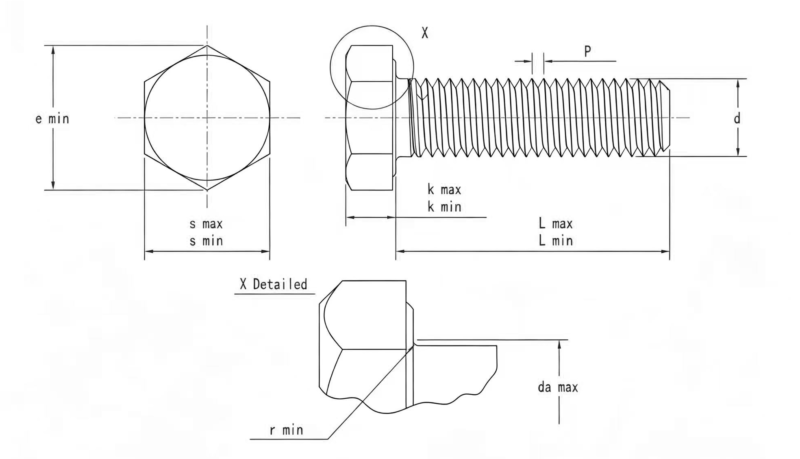
| Mon | M1.6 | M2 | M2.5 | M3 | M3.5 | M4 | M5 | M6 | M8 | M10 | M12 | M14 | M16 | M18 | M20 |
| P | 0.35 | 0.4 | 0.45 | 0.5 | 0.6 | 0.7 | 0.8 | 1 | 1.25 | 1.5 | 1.75 | 2 | 2 | 2.5 | 2.5 |
| da max | 2 | 2.6 | 3.1 | 3.6 | 4.1 | 4.7 | 5.7 | 6.8 | 9.2 | 11.2 | 13.7 | 15.7 | 17.7 | 20.2 | 22.4 |
| e min | 3.41 | 4.32 | 5.45 | 6.01 | 6.58 | 7.66 | 8.79 | 11.05 | 14.38 | 17.77 | 20.03 | 23.36 | 26.75 | 30.14 | 33.53 |
| k max | 1.225 | 1.525 | 1.825 | 2.125 | 2.525 | 2.925 | 3.65 | 4.15 | 5.45 | 6.58 | 7.68 | 8.98 | 10.18 | 11.715 | 12.715 |
| k min | 0.975 | 1.275 | 1.575 | 1.875 | 2.275 | 2.675 | 3.35 | 3.85 | 5.15 | 6.22 | 7.32 | 8.62 | 9.82 | 11.285 | 12.285 |
| r min | 0.1 | 0.1 | 0.1 | 0.1 | 0.1 | 0.2 | 0.2 | 0.25 | 0.4 | 0.4 | 0.6 | 0.6 | 0.6 | 0.6 | 0.8 |
| s max | 3.2 | 4 | 5 | 5.5 | 6 | 7 | 8 | 10 | 13 | 16 | 18 | 21 | 24 | 27 | 30 |
| s min | 3.02 | 3.82 | 4.82 | 5.32 | 5.82 | 6.78 | 7.78 | 9.78 | 12.73 | 15.73 | 17.73 | 20.67 | 23.67 | 26.67 | 29.67 |
| Mon | M20 | M22 | M24 | M27 | M30 | M33 | M36 | M39 | M42 | M45 | M48 | M52 | M56 | M60 | M64 |
| P | 2.5 | 2.5 | 3 | 3 | 3.5 | 3.5 | 4 | 4 | 4.5 | 4.5 | 5 | 5 | 5.5 | 5.5 | 6 |
| da max | 22.4 | 24.4 | 26.4 | 30.4 | 33.4 | 36.4 | 39.4 | 42.4 | 45.6 | 48.6 | 52.6 | 56.6 | 63 | 67 | 71 |
| e min | 33.53 | 37.72 | 39.98 | 45.2 | 50.85 | 55.37 | 60.79 | 66.44 | 71.3 | 76.95 | 82.6 | 88.25 | 93.56 | 99.21 | 104.86 |
| k max | 12.715 | 14.215 | 15.215 | 17.35 | 19.12 | 21.42 | 22.92 | 25.42 | 26.42 | 28.42 | 30.42 | 33.5 | 35.5 | 38.5 | 40.5 |
| k min | 12.285 | 13.785 | 14.785 | 16.65 | 18.28 | 20.58 | 22.08 | 24.58 | 25.58 | 27.58 | 29.58 | 32.5 | 34.5 | 37.5 | 39.5 |
| r min | 0.8 | 0.8 | 0.8 | 1 | 1 | 1 | 1 | 1 | 1.2 | 1.2 | 1.6 | 1.6 | 2 | 2 | 2 |
| s max | 30 | 34 | 36 | 41 | 46 | 50 | 55 | 60 | 65 | 70 | 75 | 80 | 85 | 90 | 95 |
| s min | 29.67 | 33.38 | 35.38 | 40 | 45 | 49 | 53.8 | 58.8 | 63.1 | 68.1 | 73.1 | 78.1 | 82.8 | 87.8 | 92.8 |
The difference between ISO4017 and DIN933:
DIN933 is the German standard, ISO4017 is the international standard, and the EU standard EN ISO 4014. The two are different in the size of the opposite side s and diagonal e of the outer hexagonal head, such as M10, M12, M14M22, and ISO4017 is smaller than DIN933. There is little difference in other specifications. The M10 and M12 are the most commonly used.
Mechanical Proeprty of ISO4017 Hex Bolts
ISO 898-1
Carbon steel and alloy steel hex bolts in accordance with ISO 4017 can be provided with different performance grades such as 4.8, 5.8, 8.8, 10.9 and 12.9 as per ISO 898-1. For general mechanical equipment, metal structures and industrial assembly, 8.8 grade bolts are a more common choice. When connections need to withstand higher preload and working loads, 10.9 grade or 12.9 grade can be adopted. ISO 4017 refers to full-threaded bolts. When making the actual selection, in addition to the performance grade, factors such as bolt diameter, effective engagement length and the thickness of the connecting piece also need to be considered.
ISO 3506-1
The stainless steel ISO 4017 hex bolts can be provided with different austenitic stainless steel performance grades in accordance with ISO 3506-1. A2-70 is a commonly used performance grade among the ISO 4017 stainless steel hex bolts. Bolts in the A2 series are usually produced using 304 stainless steel. They are suitable for general mechanical assembly, equipment manufacturing, and connections that require both the corrosion resistance of stainless steel and mechanical strength. A2-80 also belongs to the A2 series, but its minimum tensile strength is increased to 800 MPa. Compared with A2-70, A2-80 is more suitable for mechanical connections with higher bolt strength requirements while still needing the performance of A2-class stainless steel.
Compared with A2-70, the ISO 4017 hex bolts of A4-70 place more emphasis on stronger corrosion resistance and are suitable for equipment and structural connections in humid, outdoor, and environments with chloride or other corrosive media. A4-80’s ISO 4017 hexbolts provide a minimum tensile strength of 800 MPa based on the corrosion performance of the A4 series, and is a choice when both higher mechanical strength and better corrosion resistance are required. For high-strength stainless steel connections in outdoor, marine, or highly corrosive industrial environments, A4-80 can achieve a better balance between material corrosion resistance and bolt bearing capacity.
Application of ISO4017 hex bolts:
ISO 4017 Hex Bolts are used in a wide range of industrial fastening applications due to their fully threaded design, flexible installation characteristics and compatibility with standard metric assemblies. The selection of material and strength class depends largely on the working environment, load requirements and corrosion conditions of the application.
For general mechanical assembly and equipment manufacturing, carbon steel ISO 4017 Hex Bolts with lower strength classes are commonly selected for their cost efficiency and reliable fastening performance. Higher strength grades such as 8.8, 10.9 and 12.9 are preferred for heavy-duty machinery, steel structures, transportation equipment and applications requiring higher tensile strength and load-bearing capacity.
Stainless steel ISO 4017 Hex Bolts, including A2 and A4 grades, are widely used in environments where corrosion resistance is important. A2 stainless steel bolts are suitable for general outdoor equipment, food processing machinery and industrial applications, while A4 stainless steel bolts provide enhanced corrosion resistance for marine environments, chemical equipment and coastal installations.