
DIN6923 Hex Flange Nut
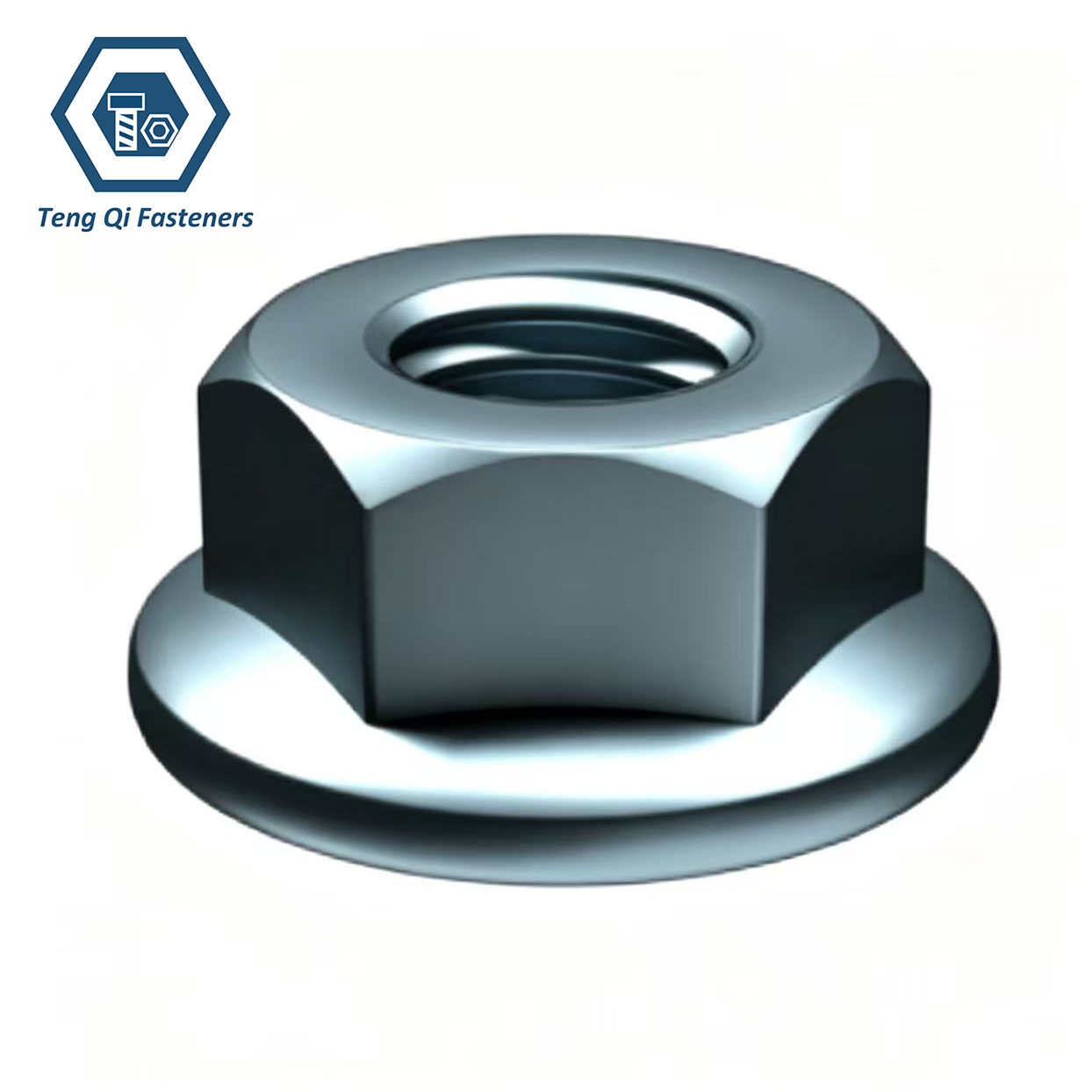
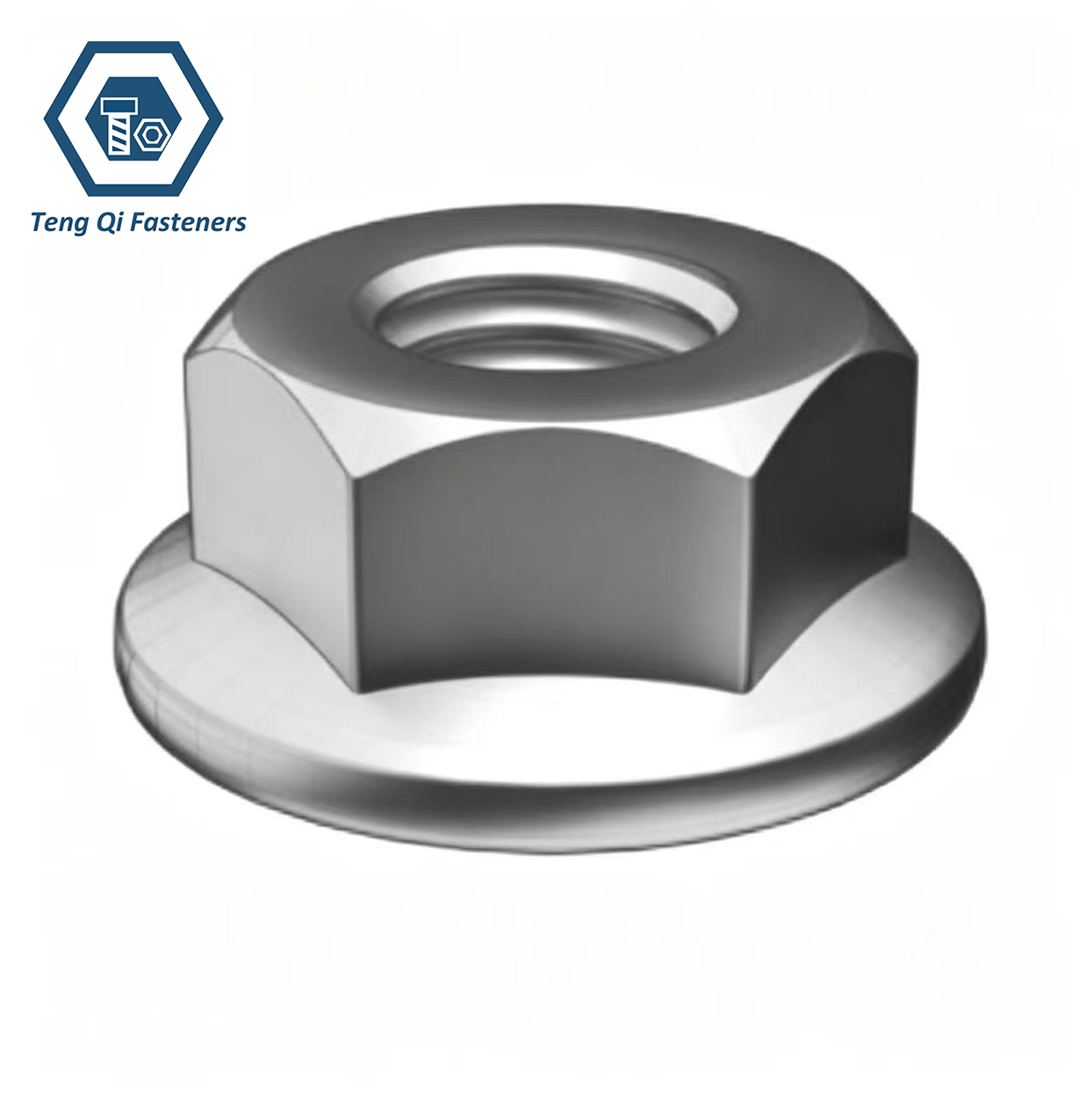
DIN 6923 Flange Nuts combine a hexagonal nut with an integrated flange that forms a larger bearing surface beneath the nut. This built-in flange spreads the clamping force over a wider area of the joint, helping reduce localized pressure on the connected component and eliminating the need for a separate washer in many fastening arrangements.
The six-sided nut body provides conventional wrench access, while the flanged underside increases the contact area against the workpiece. This makes DIN 6923 different from a standard hex nut, particularly where limited space, faster assembly, or a larger bearing surface is preferred. DIN 6923 Flange Nuts are used in machinery, equipment assemblies, fabricated metal components, brackets, frames, and general industrial fastening. They can be supplied in different materials, property classes, and surface finishes according to the requirements of the application.
Specification:
DIN 6923 Flange Nuts are specified by their metric internal thread, hexagonal dimensions, nut height, and integrated flange diameter. The built-in flange forms part of the nut itself, providing a larger bearing surface without requiring a separate loose washer in many applications. The available specification can vary by size, material, property class, and finish. For ordering, the thread diameter and pitch should be matched with the mating bolt or threaded rod, while the flange diameter should be checked against the available seating area.
| Item | Specification |
|---|---|
| Standard | DIN6923 |
| Product Type | Hexagon Flange Nut |
| Thread | Metric Internal Thread |
| Thread Pitch | Metric Coarse |
| Thread Size | M3-M20 |
| Material | Carbon Steel,Alloy Steel,Stainless Steel |
| Property Class | 5,8,10,12 A2-70 A4-70 |
| Surface Treatment | Black Oxidation,Zinc Plated, Dacromet,Bright Finish,Passivation |
Dimension Chart of DIN6923 Hex Flange Nut:
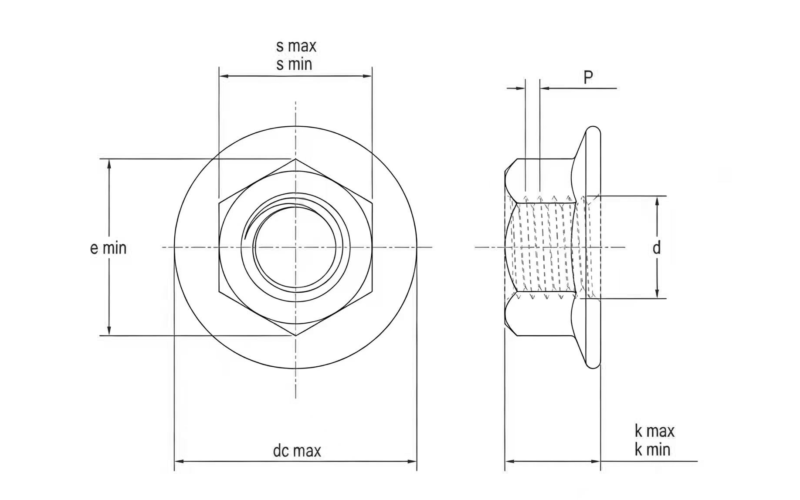
| Mon | M3 | M4 | M5 | M6 | M8 | M10 | M12 | M14 | M16 | M20 |
| P | 0.5 | 0.7 | 0.8 | 1 | 1|1.25 | 1|1.25|1.5 | 1.25|1.5|1.75 | 1.5|2 | 1.5|2 | 1.5|2|2.5 |
| dc max | 8 | 10 | 11.8 | 14.2 | 17.9 | 21.8 | 26 | 29.9 | 34.5 | 42.8 |
| e min | 6.01 | 7.66 | 8.79 | 11.05 | 14.38 | 16.64 | 20.03 | 23.36 | 26.75 | 32.95 |
| k max | 3.5 | 4.5 | 5 | 6 | 8 | 10 | 12 | 14 | 16 | 20 |
| k min | 3.2 | 4.2 | 4.7 | 5.7 | 7.6 | 9.6 | 11.6 | 13.3 | 15.3 | 18.9 |
| s max | 5.5 | 7 | 8 | 10 | 13 | 15 | 18 | 21 | 24 | 30 |
| s min | 5.32 | 6.78 | 7.78 | 9.78 | 12.73 | 14.73 | 17.73 | 20.67 | 23.67 | 29.67 |
- RELATED NUT LISTS:
- Stainless Steel DIN466 Knurled Nuts
- DIN508 Nuts for T-slots
- DIN439 Chamfered Hexagon Thin Nuts
- DIN981 Locknuts
- DIN986 Hex Domed Cap Nuts
- DIN980V Three-Point Locking Hexagon Nuts
- EN14399-3 High-strength Structural Hex Nut
- DIN6927 Prevailing Torque Three-Point Locking Flange Hexagon Nuts
- Stainless Steel DIN7967 Self-Locking Counter Nuts
- Stainless Steel DIN917 Low Type Hexagon Cap Nuts
- DIN928 Square Weld Nuts
- DIN935 Hexagon Slotted and Castle Nuts
- Stainless Steel Single Leaf Spring T-Slot Sliding Nut
- Stainless Steel Roll-in T Slot Nut for 20 Series
Application of DIN6923 Hex Flange Nut:
DIN 6923 Flange Nuts are used where a larger bearing surface is needed beneath the nut without adding a separate loose washer. The integrated flange helps distribute the clamping load around the fastening point while the hexagonal body allows conventional wrench tightening.
Machinery and Equipment Assemblies
They are commonly used in machinery, industrial equipment, machine frames, brackets, guards, and fabricated metal assemblies where fasteners are installed against relatively thin or finished components. The integrated flange can simplify assembly by combining the nut and bearing function in one component.
Sheet Metal and Fabricated Components
DIN 6923 Flange Nuts are suitable for sheet-metal assemblies, metal brackets, panels, frames, and fabricated components where a wider contact area can help reduce localized pressure around the fastening hole.
General Industrial Fastening
They are also used in equipment mounting, fixtures, support structures, mechanical assemblies, and maintenance applications where a conventional hex nut with a separate washer would otherwise require two loose components.