
DIN439 Chamfered Hexagon Thin Nuts
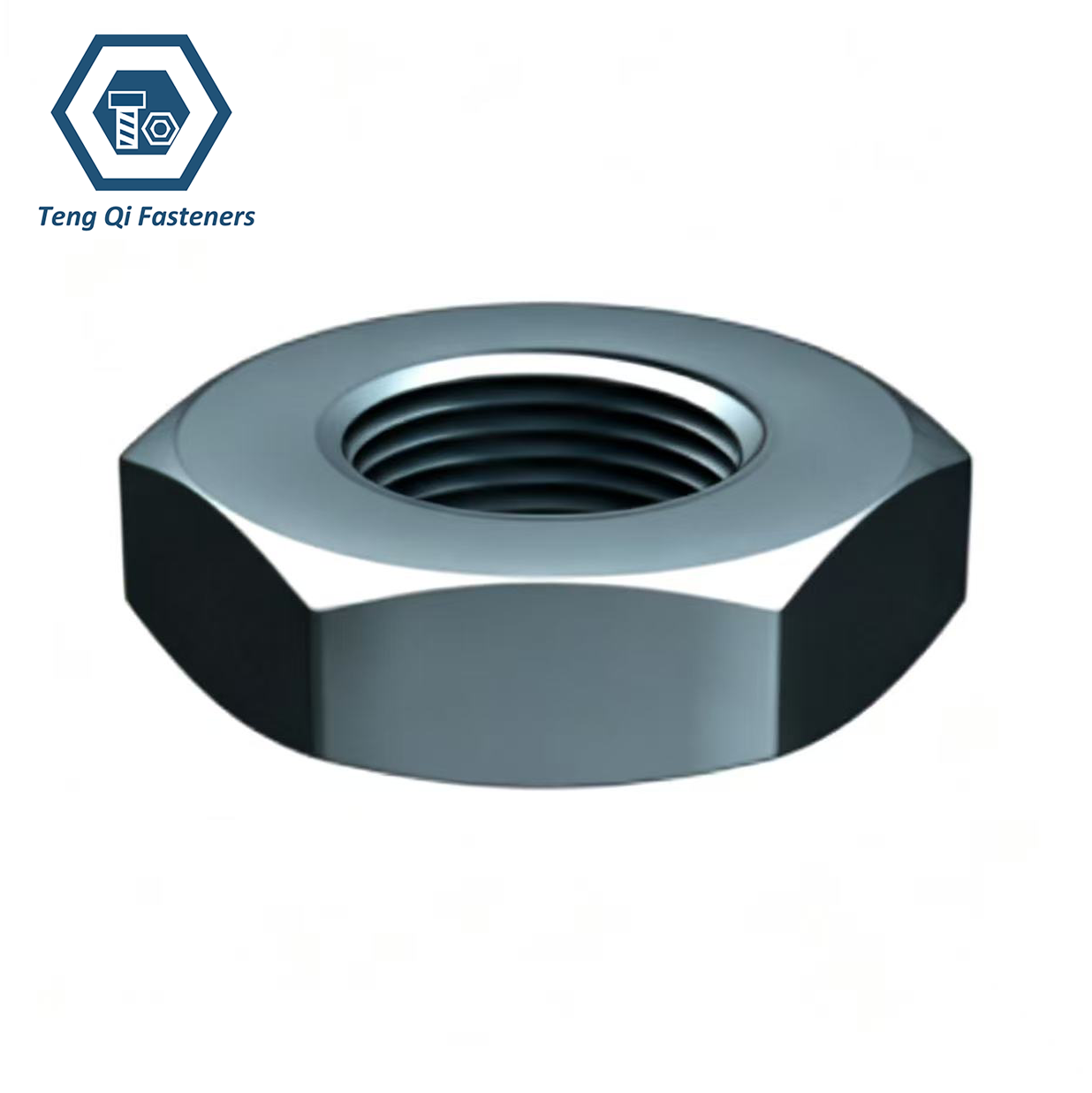
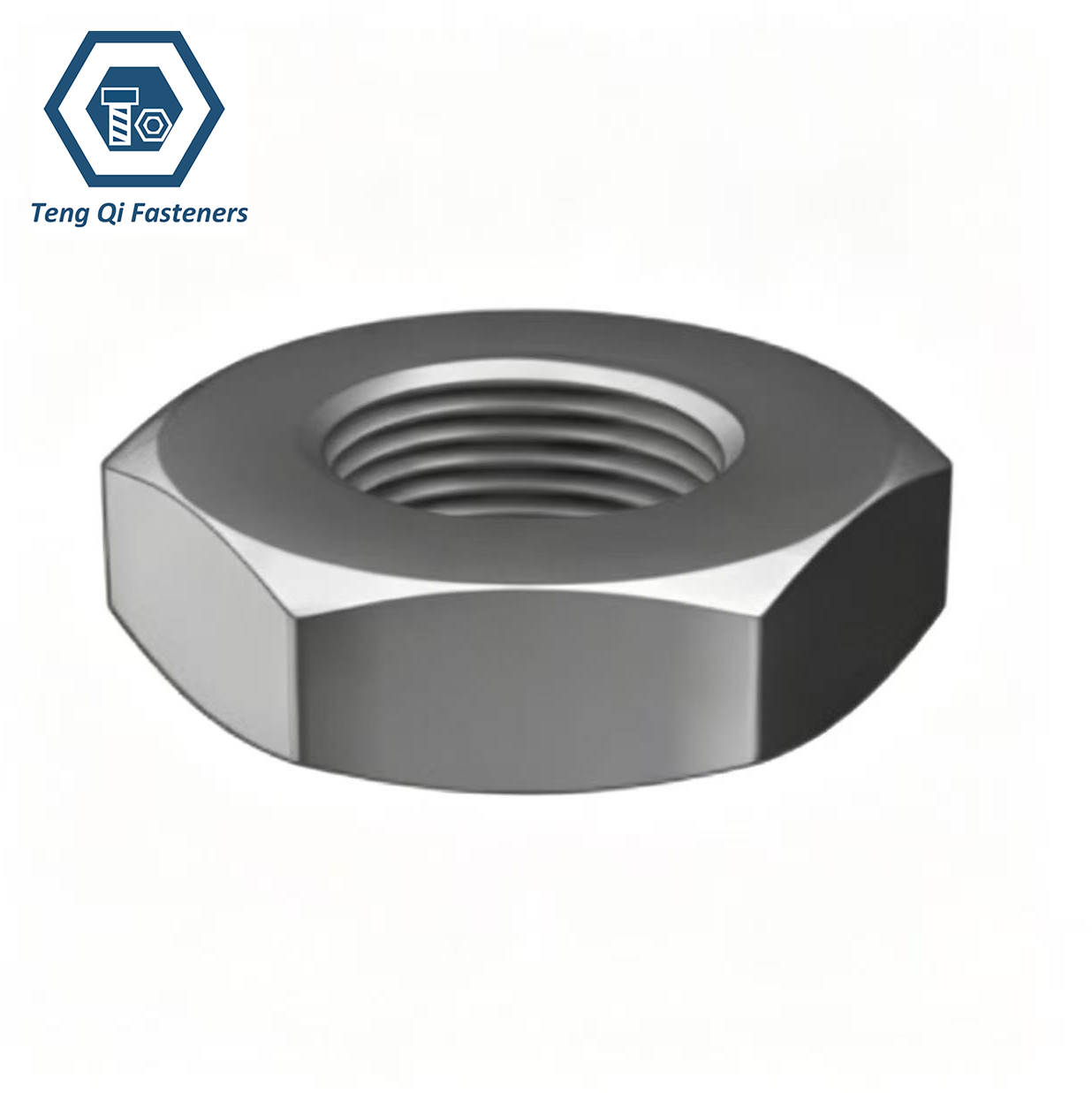
DIN 439 Chamfered Hexagon Thin Nuts provide a lower-profile alternative to standard hexagon nuts where available space above the threaded connection is limited. Their reduced nut height helps keep the assembly compact while the six-sided profile still allows the nut to be tightened with a conventional wrench or socket. The chamfered edges provide a defined transition around the nut faces and contribute to a clean, practical fastening profile.
The thinner construction is particularly useful when the nut is primarily used for locking, positioning, adjustment, or securing components without requiring the full height of a standard hex nut. It can also be used where a second nut is required in a locking arrangement or where reducing the overall height of a threaded assembly is beneficial. DIN 439 thin nuts are suitable for compact machinery, equipment assemblies, brackets, fixtures, threaded rods, and other mechanical connections where axial clearance is restricted. Carbon steel versions are commonly used for general mechanical applications, while stainless steel options are appropriate where greater resistance to moisture and corrosion is required.
Specification:
DIN 439 Chamfered Hexagon Thin Nuts are manufactured according to DIN standards and are designed with a reduced height compared with standard hexagon nuts, making them suitable for applications where installation space is limited. The chamfered edges on both sides provide smoother positioning and better tool engagement during assembly, while the precise internal threads ensure secure connection with matching bolts, studs, and threaded rods. These nuts are commonly produced in carbon steel, stainless steel, and other materials to meet different application requirements. For compact threaded assemblies, the reduced height of a DIN 439 thin nut can help maintain clearance where a standard hexagon nut would occupy more axial space. The mating bolt or threaded rod should provide sufficient thread engagement for the intended connection.
| Item | Specification |
|---|---|
| Standard | DIN439 |
| Product Type | Chamfered Hexagon Thin Nut |
| Thread | Metric Internal Thread |
| Pitch | Metric Coarse |
| Thread Size | M1.6-M52 |
| Property Class | 4,8,10 A2-70 A4-70 |
| Nut Height | Reguced/Thin Profile |
| Material | Carbon Steel,Stainless Steel, Brass |
| Surface Treatment | Bright Finish,Zinc Plated, Passivation |
Dimension Chart of DIN439 chamfered Hexagon Thin Nuts:
The DIN 439 dimension chart focuses on the compact geometry of the thin hex nut, including the internal thread, width across flats, and reduced nut height. The lower profile is the main dimensional characteristic that distinguishes DIN 439 from standard-height hex nuts and allows the nut to fit where axial clearance is limited. For each nominal size, the thread diameter and pitch determine compatibility with the mating bolt or threaded rod, while the width across flats determines the space required for wrench access. The reduced height should also be considered when checking the available thread engagement in the finished assembly.
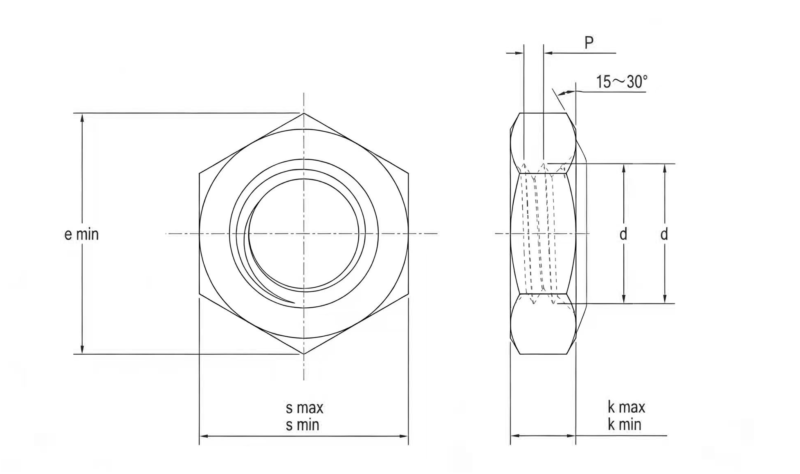
| Mon | M1.6 | M1.8 | M2 | M2.5 | M3 | M3.5 | M4 | M5 | M6 | M8 | M10 | M12 | M14 | M16 | M18 | M20 | M22 | M24 | M27 | M30 | M33 | M36 |
| P | 0.35 | 0.35 | 0.4 | 0.45 | 0.5 | 0.6 | 0.7 | 0.8 | 1 | 1|1.25 | 1|1.25|1.5 | 1.25|1.5|1.75 | 1.5|2 | 1.5|2 | 1.5|2|2.5 | 1.5|2|2.5 | 1.5|2|2.5 | 1.5|2|3 | 1.5|2|3 | 1.5|2|3.5 | 1.5|2|3.5 | 1.5|2|3|4 |
| e min | 3.48 | 3.82 | 4.32 | 5.45 | 6.01 | 6.58 | 7.66 | 8.79 | 11.05 | 14.38 | 18.9 | 21.1 | 24.49 | 26.75 | 29.56 | 32.95 | 35.03 | 39.55 | 45.2 | 50.85 | 55.37 | 60.79 |
| k max | 1 | 1.1 | 1.2 | 1.6 | 1.8 | 2 | 2.2 | 2.7 | 3.2 | 4 | 5 | 6 | 7 | 8 | 9 | 10 | 11 | 12 | 13.5 | 15 | 16.5 | 18 |
| k min | 0.75 | 0.85 | 0.95 | 1.35 | 1.55 | 1.75 | 1.95 | 2.45 | 2.9 | 3.7 | 4.7 | 5.7 | 6.42 | 7.42 | 8.42 | 9.1 | 9.9 | 10.9 | 12.4 | 13.9 | 15.4 | 16.9 |
| s max | 3.2 | 3.5 | 4 | 5 | 5.5 | 6 | 7 | 8 | 10 | 13 | 17 | 19 | 22 | 24 | 27 | 30 | 32 | 36 | 41 | 46 | 50 | 55 |
| s min | 3.08 | 3.38 | 3.82 | 4.82 | 5.32 | 5.82 | 6.78 | 7.78 | 9.78 | 12.73 | 16.73 | 18.67 | 21.67 | 23.67 | 26.16 | 29.16 | 31 | 35 | 40 | 45 | 49 | 53.8 |
- RELATED NUT LISTS:
- DIN466 Knurled Nuts
- DIN6923 Hex Flange Nut
- DIN508 Nuts for T-slots
- DIN981 Locknuts
- DIN986 Hex Domed Cap Nuts
- DIN980V Three-Point Locking Hexagon Nuts
- EN14399-3 High-strength Structural Hex Nut
- DIN6927 Prevailing Torque Three-Point Locking Flange Hexagon Nuts
- DIN7967 Self-Locking Counter Nuts
- DIN917 Low Type Hexagon Cap Nuts
- DIN928 Square Weld Nuts
- DIN935 Hexagon Slotted and Castle Nuts
- Single Leaf Spring T-Slot Sliding Nut
- Roll-in T Slot Nut for 20 Series
Application of DIN439 Chamfered Hexagon Thin Nuts:
Compact Mechanical Assemblies
DIN 439 thin nuts are useful where a conventional hex nut would take up more space along the threaded axis. They can be used for compact brackets, fixtures, mounting points, small mechanical assemblies, and components with limited clearance where a lower-profile nut is sufficient for the connection.
Locking and Positioning
The reduced height also makes DIN 439 useful for locking arrangements, component positioning, and adjustment mechanisms. In applications where two nuts are used together, the thin nut can provide additional flexibility without significantly increasing the overall height of the threaded connection.
Equipment and Electrical Components
Thin nuts can be found in equipment panels, instrument assemblies, electrical cabinets, brackets, switches, terminals, and light mechanical components where fastening hardware needs to occupy limited space. The appropriate material can be matched to the environment: carbon steel for general mechanical use, stainless steel where corrosion resistance is important, and H62 brass where good electrical conductivity, corrosion resistance, or compatibility with electrical components is required.