
DIN 6921 Flange Head Bolts
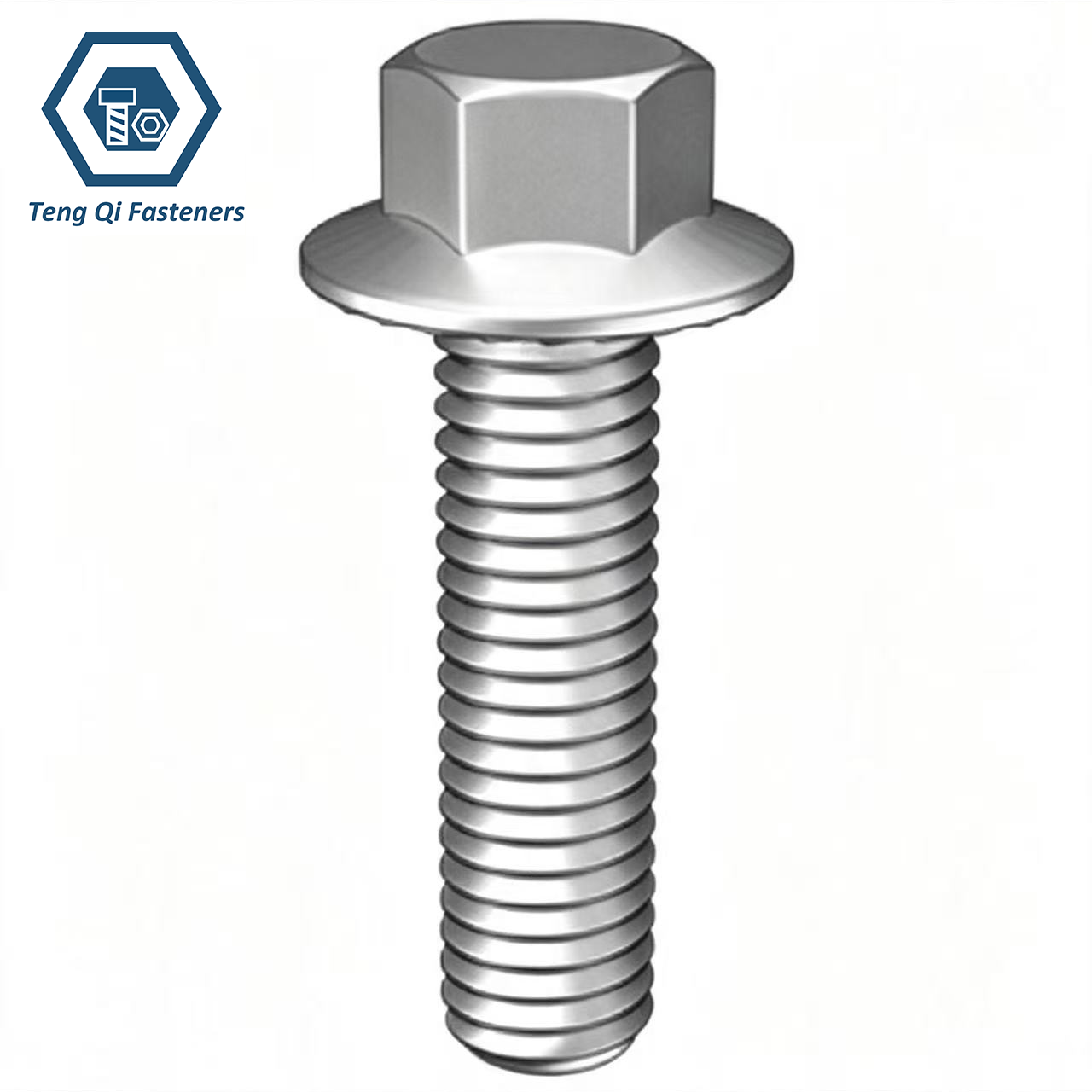
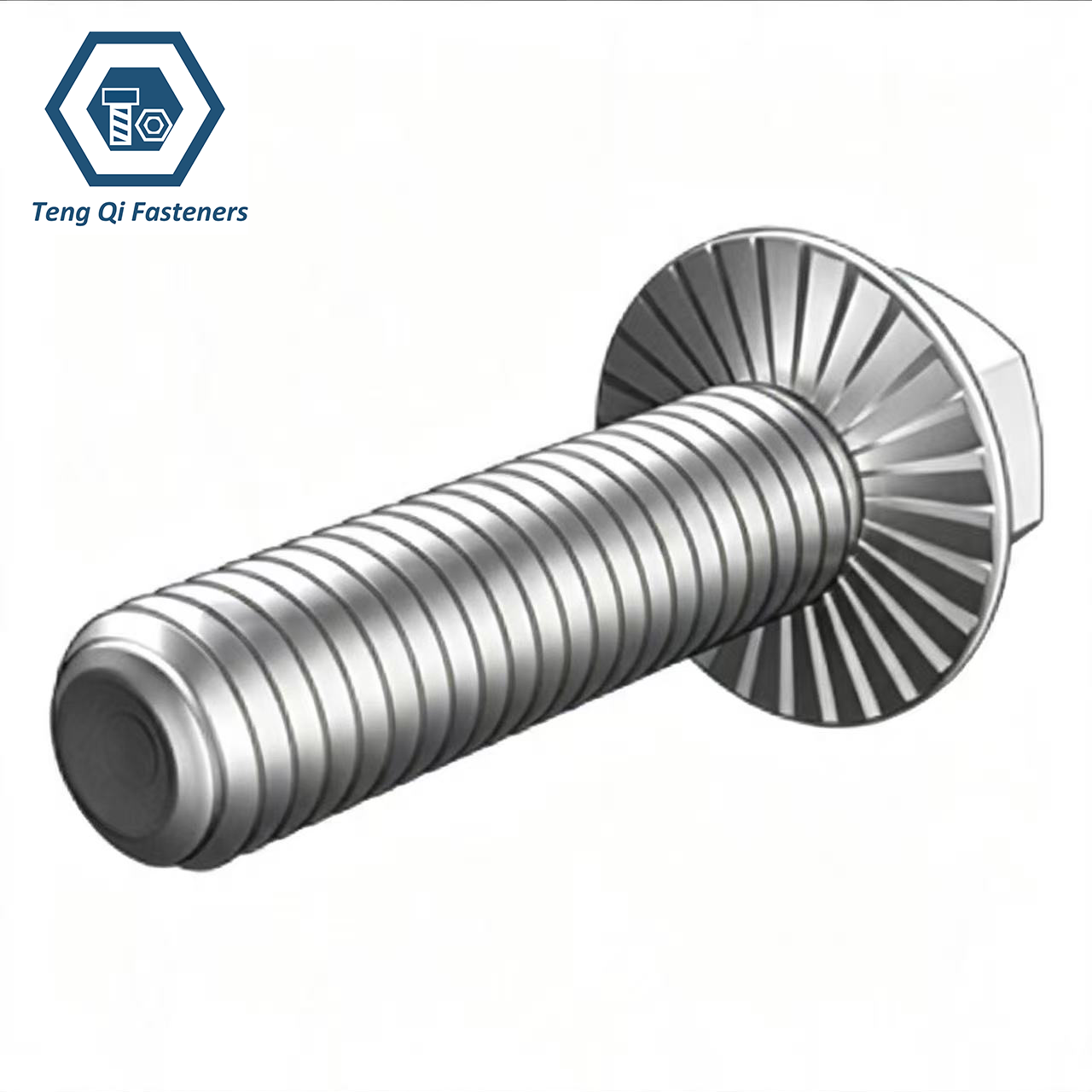
DIN 6921 Hexagon Flange Serrated Bolts combine a hexagonal head, integrated flange, and serrated bearing surface into one fastening design. The flange spreads the clamping load over a larger area than a conventional hexagon bolt head, while the serrations underneath the flange bite into the mating surface as the bolt is tightened. This combination helps increase resistance to rotational loosening and can eliminate the need for a separate washer in suitable assemblies.
The integrated flange also simplifies installation by combining the fastening and load-distribution functions in a single component. DIN 6921 serrated flange bolts are therefore well suited to assemblies where vibration resistance, consistent clamping, and reduced component count are important. The serrated flange provides direct mechanical engagement with the joint surface, while the hexagonal head allows standard tools to be used for tightening and removal.
Specification:
DIN 6921 Hexagon Flange Serrated Bolts are specified by their integrated flange, serrated bearing surface, hexagonal drive, thread configuration, and mechanical properties. The flange is formed as part of the bolt head rather than supplied as a separate washer, while the serrated underside is produced to provide consistent contact with the mating surface during tightening. The bolt can therefore be installed as a single fastening component where the joint design permits direct contact between the serrated flange and the workpiece.
For different mechanical and environmental requirements, DIN 6921 bolts can be manufactured from carbon steel, alloy steel, or stainless steel. Common property classes for steel versions include 8.8, 10.9, and 12.9, while stainless steel options such as A2-70 and A4-70 can be selected where corrosion resistance is more important. Surface treatments may include plain, black oxide, zinc plating, zinc flake coatings, or other finishes according to the base material and service environment. Thread type, length, tolerances, and coating requirements can also be specified according to the application and customer requirements.
| Item | Specification |
|---|---|
| Standard | DIN6921 |
| Product Type | Hexagon Flange Serrated Bolt |
| Head Type | Hexagon Flange Head |
| Flange | Inetregrated Serrated Flange |
| Thread Type | Metric Thread |
| Thread Diameter | M5-M20 |
| Material | Carbon Steel,Alloy Steel,Stainless Steel |
| Property Class | 8.8,10.9,12.9,A2-70,A4-70 |
| Surface Treatment | Bright Finish,Black Oxidation,Zinc Plated,Dacromet |
| Manufacturing | Cold Heading/Thread Rolling |
Dimension Chart of DIN6921 Hexagon Flange Serrated Bolts :
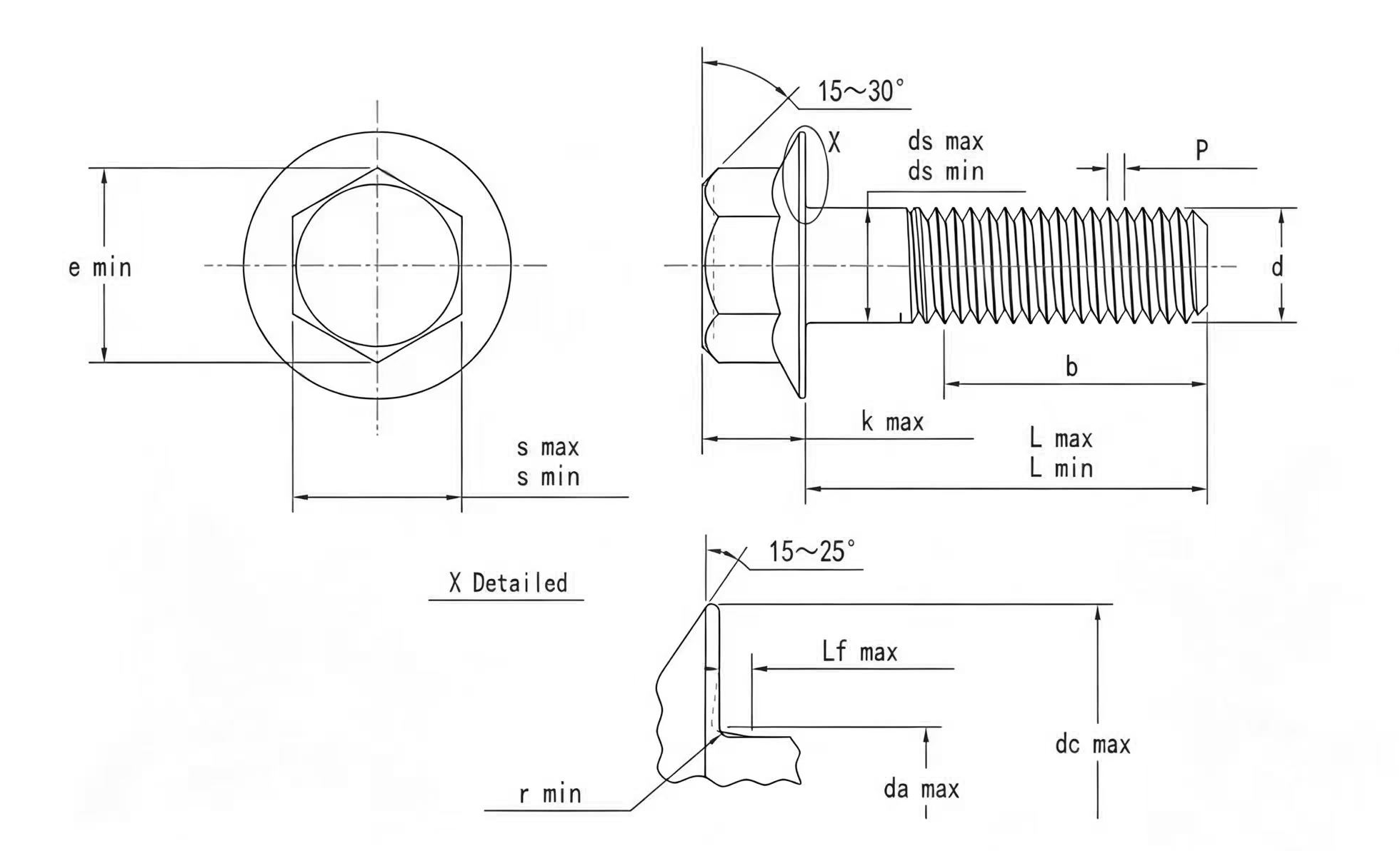
The DIN 6921 dimension chart provides the dimensional references needed to match the serrated flange bolt with the corresponding nut, threaded hole, and joint surface. In addition to the nominal thread diameter and bolt length, the flange diameter is important because it determines the bearing area beneath the bolt head. The hexagon head dimensions define the tool engagement, while the flange thickness and serrated profile affect how the bolt seats against the mating surface during tightening.
The chart can be used to check the main dimensions of each DIN 6921 size, including thread diameter (d), bolt length (l), hexagon head width across flats (s), head height (k), flange diameter (dc), and flange thickness. The serrated underside should also be considered when the bolt is installed directly against a coated, painted, or finished surface, as the teeth need sufficient contact with the mating material to provide the intended mechanical engagement.
| Mon | M5 | M6 | M8 | M10 | M12 | M14 | M16 | M20 |
| P | 0.8 | 1 | 1|1.25 | 1|1.25|1.5 | 1.25|1.5|1.75 | 1.5|2 | 1.5|2 | 1.5|2.5 |
| da max | 5.7 | 6.8 | 9.2 | 11.2 | 13.7 | 15.7 | 17.7 | 22.4 |
| dc max | 11.8 | 14.2 | 18 | 22.3 | 26.6 | 30.5 | 35 | 43 |
| ds max | 5 | 6 | 8 | 10 | 12 | 14 | 16 | 20 |
| ds min | 4.82 | 5.82 | 7.78 | 9.78 | 11.73 | 13.73 | 15.73 | 19.67 |
| e min | 8.71 | 10.95 | 14.26 | 16.5 | 17.62 | 19.86 | 23.15 | 29.87 |
| Lf max | 1.4 | 2 | 2 | 2 | 3 | 3 | 3 | 4 |
| k max | 5.4 | 6.6 | 8.1 | 9.2 | 11.5 | 12.8 | 14.4 | 17.1 |
| r min | 0.25 | 0.4 | 0.4 | 0.4 | 0.6 | 0.6 | 0.6 | 0.8 |
| s max | 8 | 10 | 13 | 15 | 16 | 18 | 21 | 27 |
| s min | 7.78 | 9.78 | 12.73 | 14.73 | 15.73 | 17.73 | 20.67 | 26.67 |
- RELATED BOLT LISTS:
- FLANGE BOLTS
- DIN 6921 FLANGE BOLTS
- JIS 1189 FLANGE BOLTS
- ASME B 18.2.1 FLANGE BOLTS
- HEX BOLTS
- DIN933 HEX BOLTS
- ISO 4017 HEX BOLTS
- ISO 4014 HEX BOLTS
- ASME B 18.2.1 HEX BOLTS
- HEAVY HEX BOLTS
- DIN 6914 STRUCTURAL BOLTS
- AS 1252 STRUCTURAL BOLTS
- ASME B 18.2.1 HEAVY HEX BOLTS
- ASME B 18.2.6 HEAVY HEX BOLTS
- JIS 1186 BOLTS
- EN 14399-3 BOLTS
- EN 14399-4 BOLTS
Mechanical Property of DIN6921:
ISO 898-1 High-Strength Flange Bolts
Carbon and alloy steel DIN 6921 flange bolts are available in common property classes such as 8.8, 10.9, and 12.9. Their mechanical properties are specified according to ISO 898-1, including tensile strength, yield strength, proof load, and hardness requirements. The selected property class should correspond to the strength requirements of the flange connection.
ISO 3506-1 Stainless Steel Flange Bolts
For stainless steel DIN 6921 flange bolts, ISO 3506-1 covers the mechanical requirements for austenitic stainless steel fasteners. Our range includes 304/304L stainless steel flange bolts and 316/316L stainless steel flange bolts, with A2-70, A2-80, A4-70, and A4-80 property classes available for different strength requirements. A2-70 and A2-80 flange bolts have minimum tensile strengths of 700 MPa and 800 MPa respectively, while A4-70 and A4-80 flange bolts follow the corresponding 700 MPa and 800 MPa strength levels. The final grade and property class are selected together with the stainless steel material and the required dimensions of the DIN 6921 flange bolt.
Application of DIN6921 Hexagon Flange Serrated Bolts :
DIN 6921 Hexagon Flange Serrated Bolts are useful in assemblies where a broad bearing surface and resistance to rotational movement are required from the same fastening component. In automotive and transportation equipment, they can be used for seat frames, exhaust brackets, chassis components, suspension-related brackets, and engine-bay sheet-metal assemblies. In industrial equipment, the bolts are suitable for conveyor frames, robotic arm joints, packaging machines, compressor housings, welding fixtures, and machine guards, particularly where vibration or repeated movement may affect conventional bolted connections.
The choice of property class or stainless steel grade can be matched to the mechanical load and service environment. 8.8 versions are suitable for general machine construction, agricultural implements, material-handling equipment, and fabricated steel assemblies. 10.9 and 12.9 versions are better suited to highly loaded joints such as die clamping systems, heavy-duty lifting fixtures, drive assemblies, and high-load mechanical linkages. A2-70 stainless steel bolts can be used in food-processing machines, commercial kitchen equipment, outdoor electrical enclosures, and packaging equipment, while A4-70 versions are appropriate for marine hardware, wastewater equipment, chemical-processing installations, and other applications exposed to moisture or corrosive environments.