
DIN25201 Double Fold Self-locking Washer Pairs
Pairs use a two-piece wedge-locking structure to resist loosening in bolted joints exposed to vibration and dynamic movement. The two washers are supplied together with their inclined inner surfaces facing each other, while the radial teeth on the outer surfaces engage with the bolt head or nut and the joint surface. This creates a different locking mechanism from conventional washers that rely mainly on friction.
When vibration causes relative movement in the joint and creates a tendency for the fastener to rotate, the two washer halves can move against each other along their inclined inner surfaces. The wedge geometry converts this movement into an increase in tension within the joint, resisting further loosening. When the joint returns from the displaced position, the washer pair helps maintain the original clamping condition. The locking effect is therefore generated by the wedge surfaces and surface engagement, rather than by adhesive or friction alone. The washers are supplied as a pre-assembled pair, making it easier to maintain the correct orientation during installation. They are best suited to relatively flat and smooth metallic contact surfaces where the outer teeth can engage effectively. For non-metallic joint materials, a suitable metal plate can be introduced at the fastening location to provide an appropriate contact surface for the locking washer.
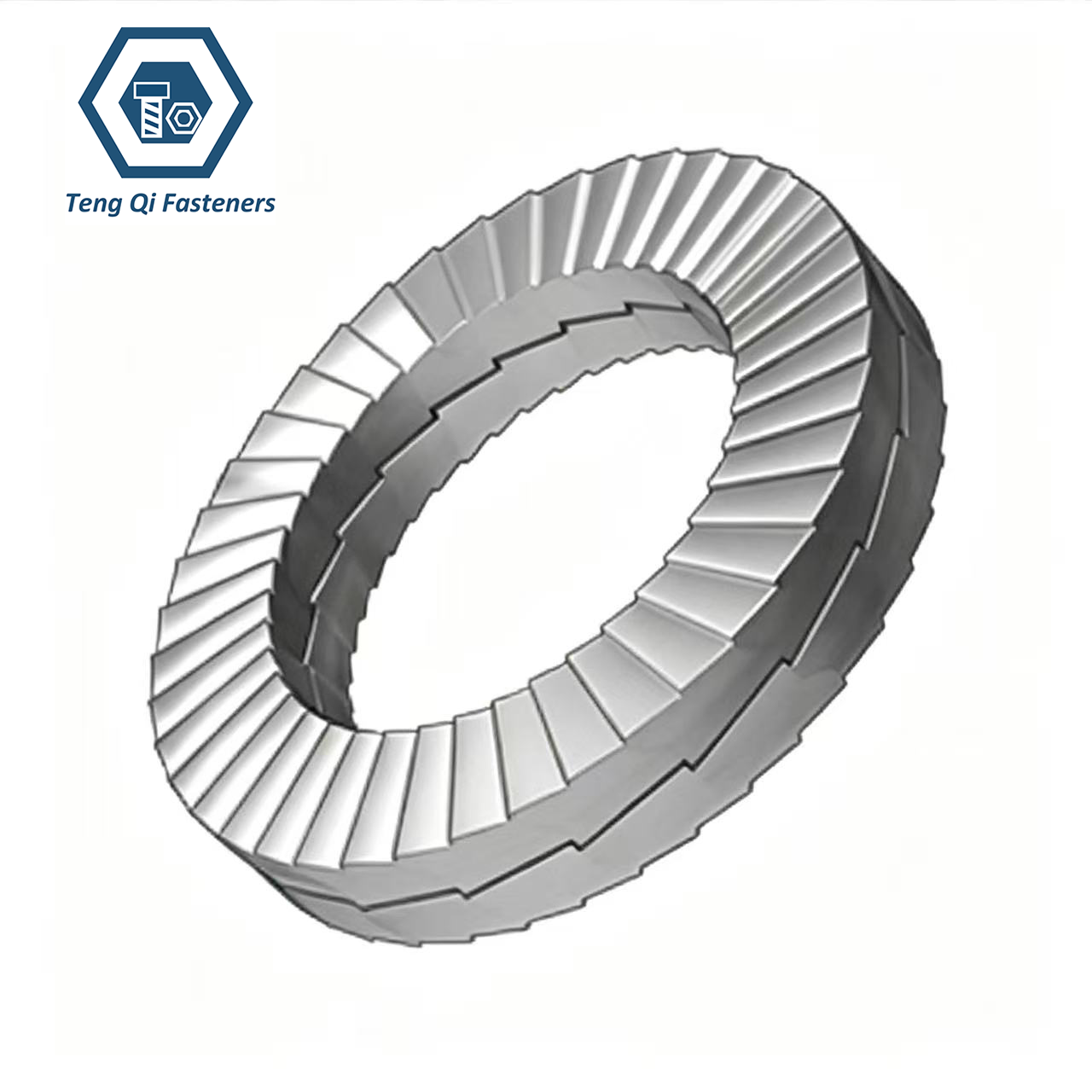
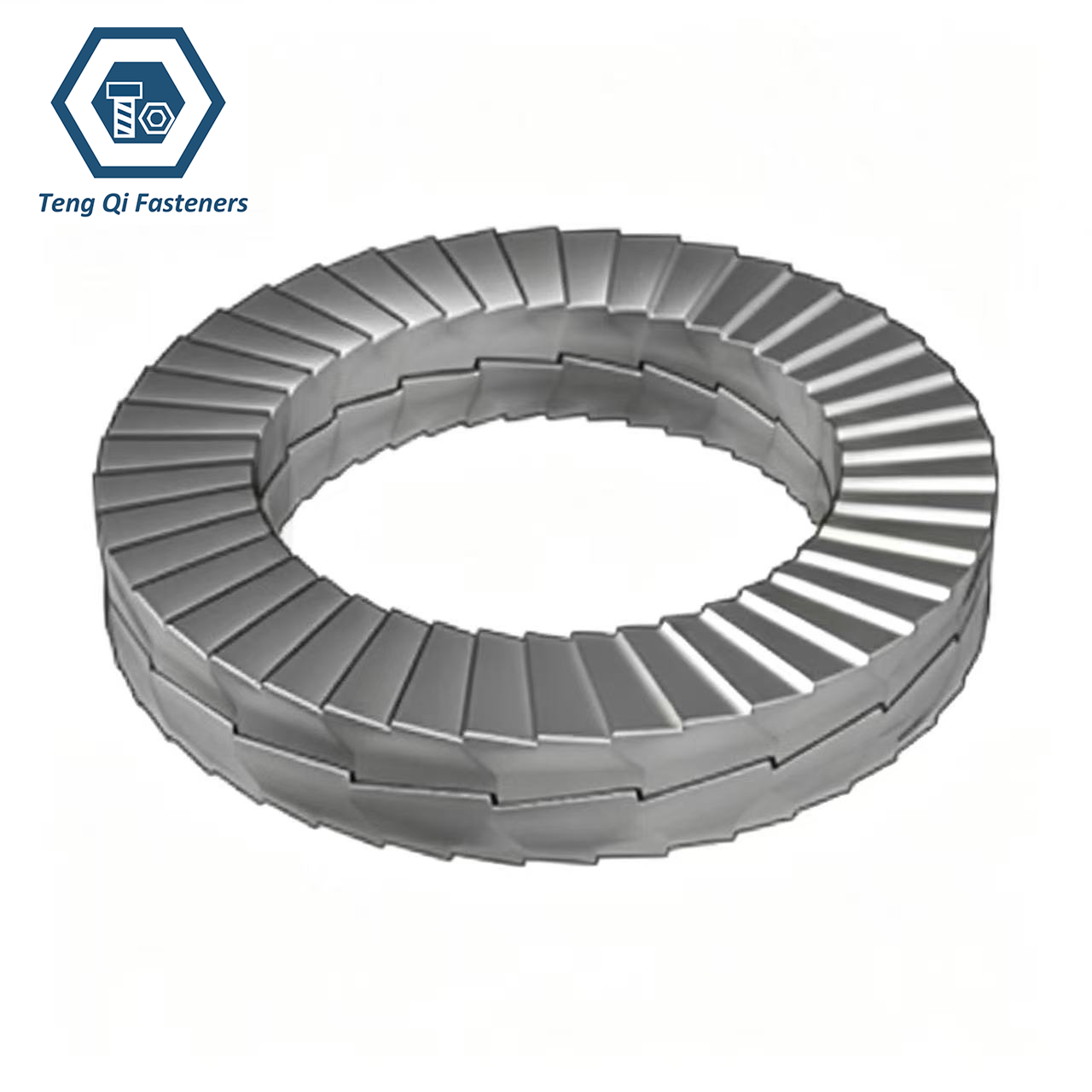
Specification:
DIN 25201 self-locking washer pairs consist of two matching washers with opposing wedge surfaces on the inside and radial teeth on the outside. The two components are supplied as a pre-assembled pair and installed with the wedge surfaces facing each other. The outer teeth are intended to engage with relatively flat and smooth contact surfaces, while the inclined inner surfaces provide the wedge-locking action between the two washers. Key specifications include nominal bolt size, inside diameter, outside diameter, combined washer thickness, material, hardness, and surface finish. Carbon steel and stainless steel options can be selected according to the mechanical and environmental requirements of the joint. During installation, the washer pair does not depend on a special locking adhesive, and conventional hand tools or powered installation equipment can be used according to the requirements of the assembly.
| Item | Specification |
|---|---|
| Product Type | Double Fold Self-Locking Washers |
| Standard | DIN25201 |
| Configuration | Two-piece Pre-assembled Pair |
| Locking Pinciple | Wedge Locking |
| Inner Surface | Inclined/Wedge Teeth |
| Outer Surface | Radial Teeth |
| Material | 254SMo,27MnCrb5, 65Mn,EN1.4404,EN1.4547,EN1.7225 S60C,SK5,SS304 SS316 SS316L |
| Inner Diamter | Φ3-Φ130 |
| Surface Treatment | Dacromet, Bright Pickling |
| Hardness | 39-44HRC,42-47HRC,min520HV |
Dimension Chart of DIN25201 Double Fold Self-locking Washers:
The DIN 25201 dimension chart provides the key measurements for selecting the correct self-locking washer pair according to the mating bolt size. Since each product consists of two matching washers supplied as a pre-assembled pair, the dimensions should be considered for the complete washer configuration as well as for the individual washer geometry. Key dimensions include the nominal bolt size, inner diameter (d1), outer diameter (d2), and washer thickness (s). The inner diameter determines compatibility with the bolt shank, while the outer diameter defines the contact area beneath the bolt head or nut. The washer thickness is also relevant when checking the available space and the overall stack height of the bolted joint.
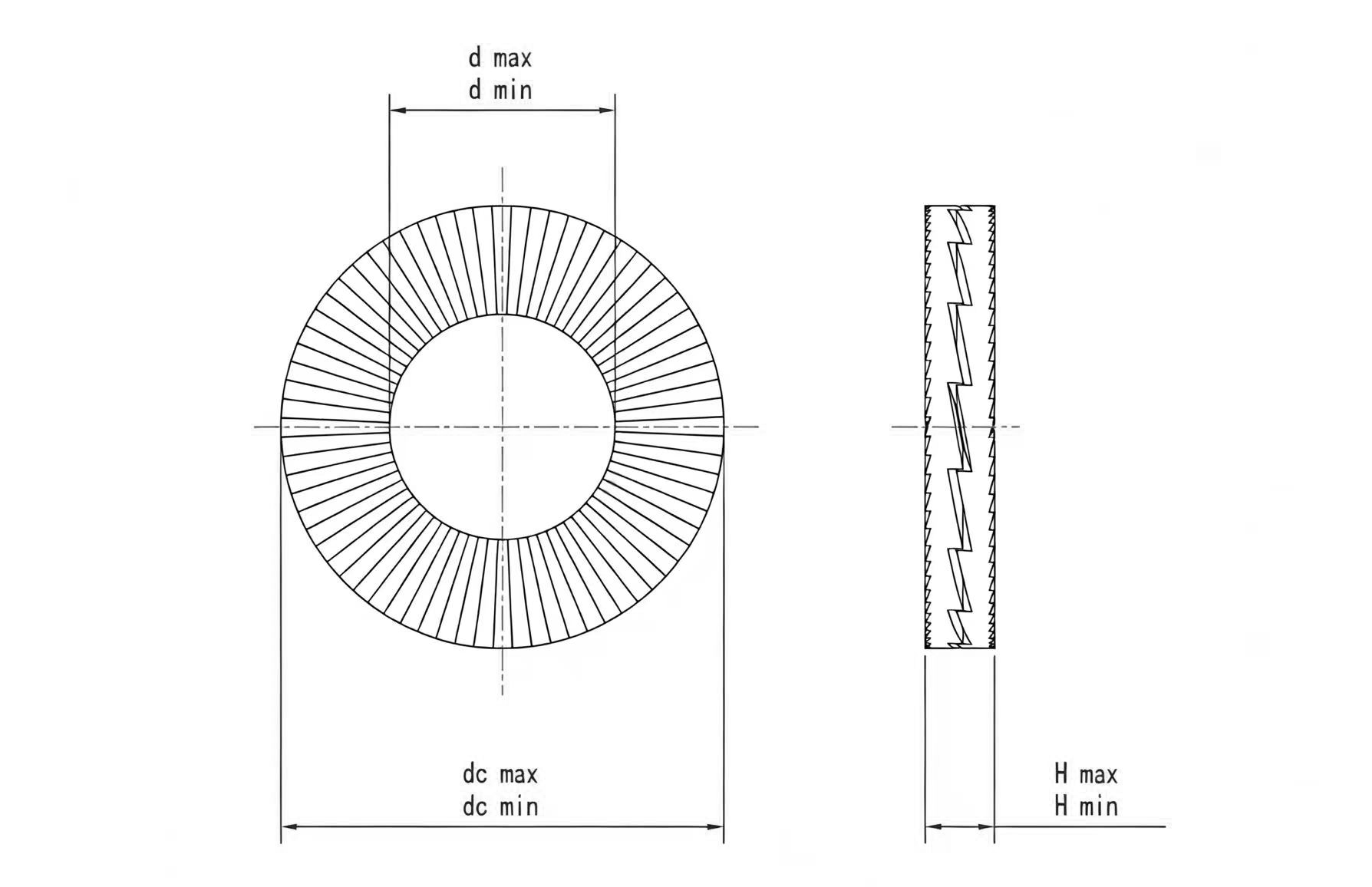
| Mon | Φ3 | Φ3.5 | Φ4 | Φ5 | Φ6 | Φ8 | Φ10 | Φ12 | Φ14 | Φ16 | Φ18 | Φ20 | Φ22 | Φ24 | Φ27 | Φ30 |
| d max | 3.5 | 4 | 4.5 | 5.5 | 6.6 | 8.8 | 10.9 | 13.2 | 15.4 | 17.2 | 19.7 | 21.6 | 23.6 | 25.5 | 28.6 | 31.6 |
| d min | 3.3 | 3.8 | 4.3 | 5.3 | 6.3 | 8.6 | 10.5 | 12.8 | 15 | 16.8 | 19.3 | 21.2 | 23.2 | 25.1 | 28.2 | 31.2 |
| dc max | 7.2 | 7.8 | 7.8 | 9.2 | 11 | 13.7 | 16.8 | 19.7 | 23.2 | 25.6 | 29.2 | 30.9 | 34.7 | 39.2 | 42.3 | 47.3 |
| dc min | 6.8 | 7.4 | 7.4 | 8.8 | 10.6 | 13.3 | 16.3 | 19.3 | 22.8 | 25.2 | 28.8 | 30.5 | 34.3 | 38.8 | 41.7 | 46.7 |
| H max | 2.05 | 2.05 | 2.05 | 2.05 | 2.05 | 2.75 | 2.75 | 2.75 | 3.65 | 3.65 | 3.65 | 3.65 | 3.65 | 3.65 | 6.05 | 6.05 |
| H min | 1.55 | 1.55 | 1.55 | 1.55 | 1.55 | 2.25 | 2.25 | 2.25 | 3.15 | 3.15 | 3.15 | 3.15 | 3.15 | 3.15 | 5.55 | 5.55 |
| Mon | Φ27 | Φ30 | Φ33 | Φ36 | Φ39 | Φ42 | Φ45 | Φ48 | Φ52 | Φ56 | Φ60 | Φ64 | Φ68 | Φ70 | Φ76 | Φ80 |
| d max | 28.6 | 31.6 | 34.6 | 37.6 | 40.6 | 43.5 | 46.7 | 50.1 | 54.1 | 59.6 | 63.6 | 67.6 | 71.6 | 75.6 | 79.6 | 83.6 |
| d min | 28.2 | 31.2 | 34.2 | 37.2 | 40.2 | 43 | 46.2 | 49.6 | 53.6 | 59.1 | 63.1 | 67.1 | 71.1 | 75.1 | 79.1 | 83.1 |
| dc max | 42.3 | 47.3 | 48.8 | 55.3 | 58.8 | 63.3 | 70 | 75 | 80 | 85 | 90 | 95 | 100 | 105 | 110 | 115 |
| dc min | 41.7 | 46.7 | 48.2 | 54.7 | 58.2 | 62.7 | 68 | 73 | 78 | 83 | 88 | 93 | 98 | 103 | 108 | 113 |
| H max | 6.05 | 6.05 | 6.05 | 6.05 | 6.05 | 6.05 | 7.75 | 7.75 | 7.75 | 7.75 | 7.75 | 7.75 | 10.25 | 10.25 | 10.25 | 10.25 |
| H min | 5.55 | 5.55 | 5.55 | 5.55 | 5.55 | 5.55 | 6.25 | 6.25 | 6.25 | 6.25 | 6.25 | 6.25 | 8.75 | 8.75 | 8.75 | 8.75 |
- RELATED WASHER LISTS:
- DIN125 Flat Washer
- DIN127 Spring Lock Washer
- F436 Hardened Steel Washers
- DIN9021 Large Washer
- ASME/ANSI B 18.21.1 (USS) Flat Washer
- ASME/ANSI B 18.21.1 (SAE) Flat Washer
- ASME/ANSI B18.21.1 Helical Spring-Lock Washer
- DIN6797A Stainless Steel External Teeth Lock Washers
- Stainless Steel DIN6797J Internal Teeth Lock Washers
Application of DIN25201 Double Fold Self-locking Washer:
Vibration-Prone Machinery and Equipment
The wedge-locking structure of DIN 25201 makes the washer pair suitable for bolted joints exposed to vibration, cyclic movement, and dynamic loading. Typical applications include electric motors, gearboxes, pumps, compressors, machine tools, conveyor systems, agricultural machinery, construction equipment, railway equipment, and industrial production machinery. The washer pairs can be used around motor mounts, equipment housings, support brackets, machine guards, inspection covers, and other bolted connections where maintaining the clamping condition is important during operation.
Equipment with Suitable Contact Surfaces
The radial teeth on the outer faces are intended to engage with relatively flat and smooth metallic contact surfaces, allowing the washer pair to work effectively beneath a bolt head or nut. For this reason, DIN 25201 is particularly suitable for fabricated steel frames, machined equipment parts, mounting plates, and other metallic assemblies with an appropriate seating surface. Where the joint material is non-metallic, a metal contact plate can be added at the fastening location to provide a suitable surface for the outer teeth. Carbon steel versions are suitable for general industrial equipment, while stainless steel versions are useful for outdoor machinery, water-related equipment, food-processing equipment, and moisture-exposed assemblies where corrosion resistance is important.
Installation Considerations
For correct installation, place the two washers with their wedge-shaped inner surfaces facing each other. The outer toothed surfaces should face the bolt head or nut on one side and the joint material on the other. The contact surfaces should be sufficiently flat and smooth to allow the outer teeth to engage properly.
For non-metallic joint materials, a metal plate or suitable metallic contact surface can be provided beneath the washer so that the outer teeth have an appropriate surface to engage with.