
DIN916 Cup point Hexagon Socket Set Screws
DIN 916 Hexagon Socket Set Screws feature a cup point designed to provide secure contact with the mating component while the screw is tightened inside a threaded hole. The recessed point allows the screw to grip the surface without requiring a sharp cone or projecting tip, making it suitable for positioning and securing components where a controlled clamping contact is preferred. The internal hexagon drive allows the screw to be installed in compact or recessed locations where access for a conventional wrench is limited. DIN 916 set screws can be used to secure shafts, collars, knobs, gears, guides, and other components against movement within threaded holes.
We supply DIN 916 set screws in carbon steel, alloy steel, and stainless steel, with different strength grades and surface finishes available according to the application. Stainless steel versions can be selected for corrosion-resistant environments, while hardened steel versions are suitable where higher clamping and wear resistance are required. Compared with other DIN set screw point styles, the cup point provides a different balance between holding force, surface contact, and potential marking of the mating component. The appropriate point design should therefore be selected according to whether the priority is secure positioning, surface protection, or resistance to movement.
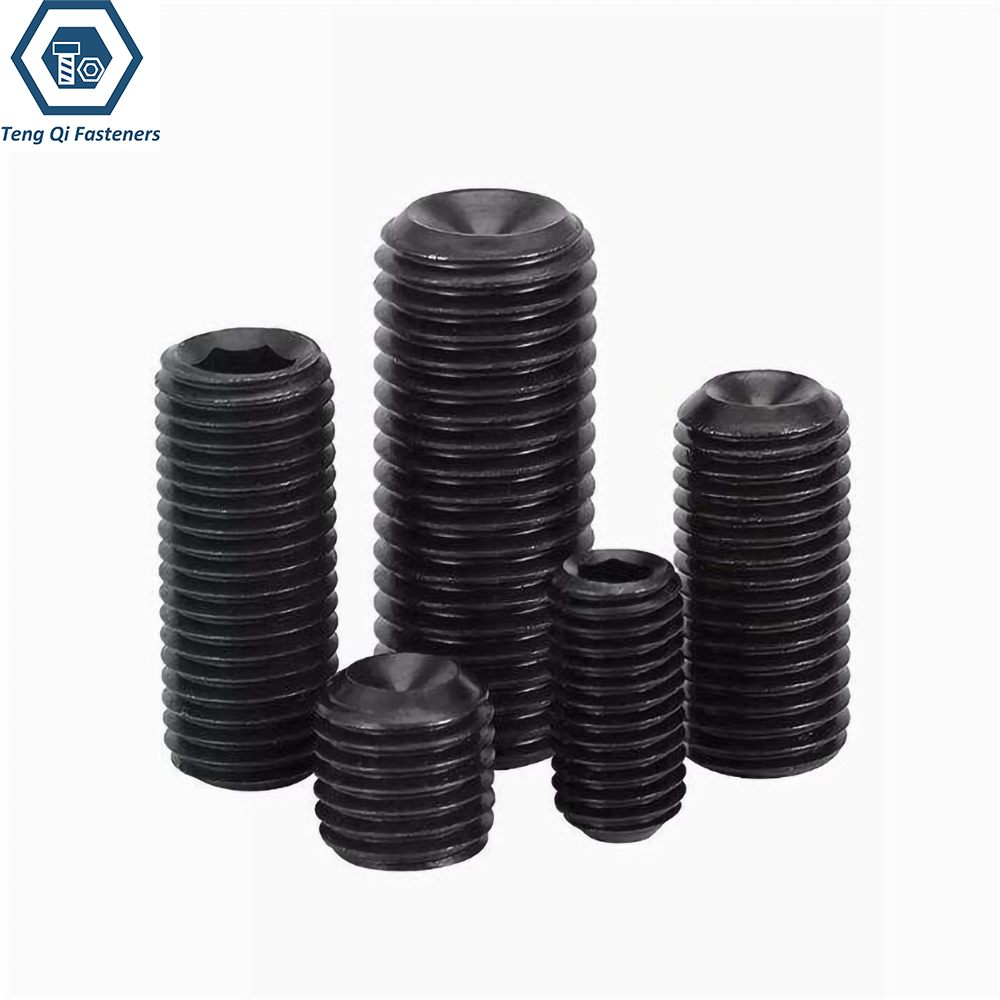
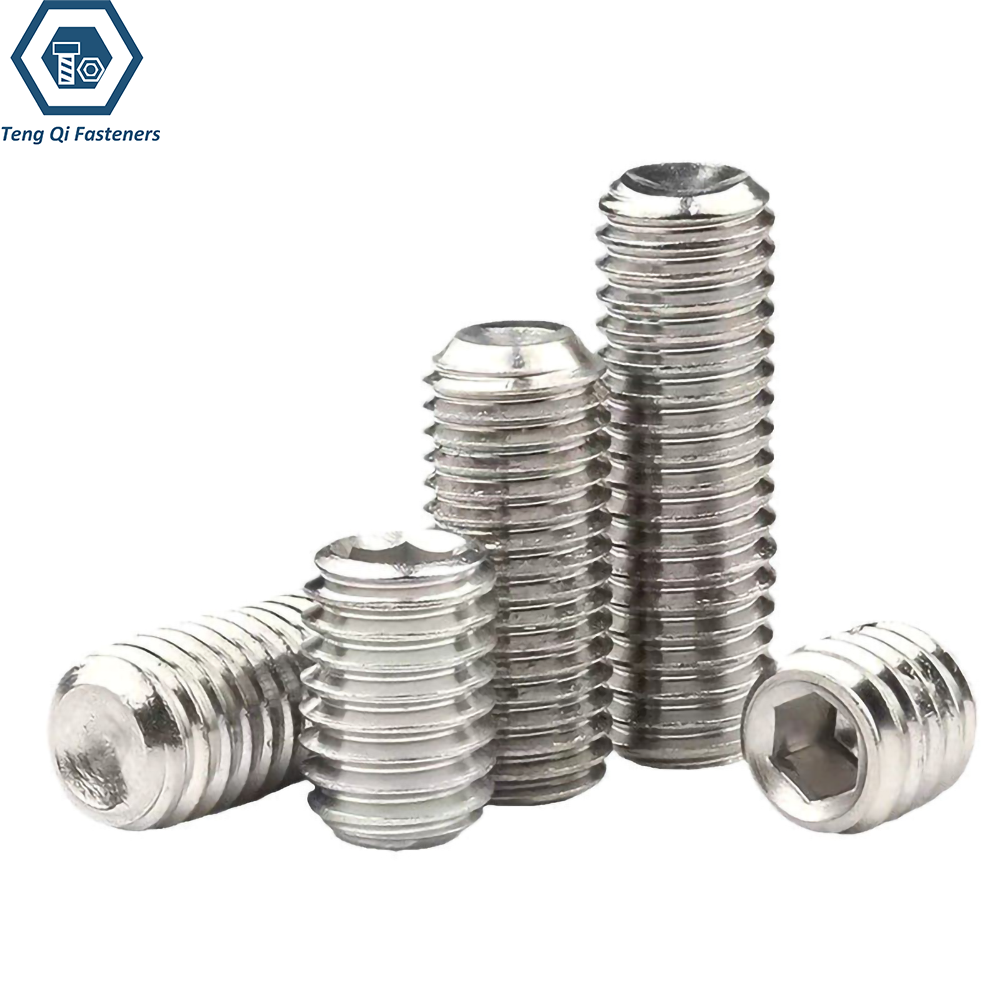
Specification:
DIN 916 set screws are available in carbon steel, alloy steel, and stainless steel, with material and mechanical properties selected according to the required clamping force, wear resistance, and service environment. The standard configuration uses a metric coarse thread with an internal hexagon drive and cup point. For steel versions, hardened grades can be supplied for applications requiring higher resistance to deformation and wear, while stainless steel versions are suitable where corrosion resistance is more important.
Material & Performance
For carbon and alloy steel, DIN 916 set screws can be supplied with suitable heat treatment to improve hardness and resistance to wear during repeated clamping. Stainless steel versions are available for applications where corrosion resistance is more important than maximum hardness.
Selection Note: The required hardness and material should be selected according to the mating component. A hardened cup-point screw can provide strong holding performance, but may leave a mark on softer shafts or surfaces. For applications where surface damage must be minimized, the point style and material should be considered together.
| Item | Specification |
| Standard | DIN916 |
| Product Type | Hexagon Socket Set Screw with Cup Point |
| Point Type | Cup Point |
| Thread | Metric Coarse |
| Thread Tolerance | 6g |
| Mechanical Property Standard | ISO898-5/ISO3506 |
| Steel Class | 45H |
| Stainless Steel Class | A2-70,A2-80,A4-70,A4-80 |
| Type | Hexagon socket set screw with a cup point |
| Material | Carbon Steel,Alloy Steel,Stainless Steel |
| Surface Finish | Black Oxidation,Zinc Plated,Bright Finish,Passivation |
| Inspection | Dimensions,Thread,Hardness,Coating |
Dimension Chart of DIN916 Set Screw:
The dimension chart covers the main measurements of DIN 916 set screws, including thread size, overall length, cup point geometry, and internal hexagon dimensions. The screw length should be selected according to the available threaded hole depth and the required engagement with the mating component. When choosing a DIN 916 set screw, the hexagon socket size and cup point position should also be considered to ensure adequate tool access and consistent clamping. Custom dimensions can be produced according to drawings when a standard size does not meet the assembly requirements.
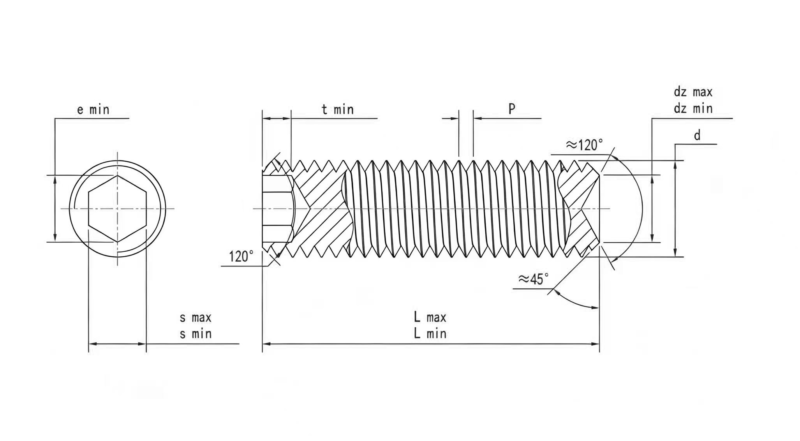
| Mon | M1.4 | M1.6 | M1.8 | M2 | M2.5 | M3 | M4 | M5 | M6 | M8 | M10 | M12 | M14 | M16 | M18 | M20 | M22 | M24 |
| P | 0.3 | 0.35 | 0.35 | 0.4 | 0.45 | 0.5 | 0.7 | 0.8 | 1 | 1.25 | 1.5 | 1.75 | 2 | 2 | 2.5 | 2.5 | 2.5 | 3 |
| dz max | 0.7 | 0.8 | 0.9 | 1 | 1.2 | 1.4 | 2 | 2.5 | 3 | 5 | 6 | 8 | 9 | 10 | 12 | 14 | 16 | 16 |
| dz min | 0.45 | 0.55 | 0.65 | 0.75 | 0.95 | 1.15 | 1.75 | 2.25 | 2.75 | 4.7 | 5.7 | 7.64 | 8.64 | 9.64 | 11.57 | 13.57 | 15.57 | 15.57 |
| e min | 0.803 | 0.803 | 0.803 | 1.003 | 1.427 | 1.73 | 2.3 | 2.87 | 3.44 | 4.58 | 5.72 | 6.86 | 6.86 | 9.15 | 11.43 | 11.43 | 13.72 | 13.72 |
| s min | 0.711 | 0.711 | 0.711 | 0.889 | 1.27 | 1.52 | 2.02 | 2.52 | 3.02 | 4.02 | 5.02 | 6.02 | 6.02 | 8.025 | 10.025 | 10.025 | 12.032 | 12.032 |
| s max | 0.724 | 0.724 | 0.724 | 0.902 | 1.295 | 1.545 | 2.045 | 2.56 | 3.08 | 4.095 | 5.095 | 6.095 | 6.095 | 8.115 | 10.115 | 10.115 | 12.142 | 12.142 |
| t min | 0.6 | 0.7 | 0.8 | 0.8 | 1.2 | 1.2 | 1.5 | 2 | 2 | 3 | 4 | 4.8 | 5.6 | 6.4 | 7.2 | 8 | 9 | 10 |
Application of DIN916 Set Screw:
Shaft and Collar Locking
DIN 916 set screws are commonly used to secure shafts, collars, hubs, knobs, and other components against rotation or axial movement. The cup point provides a defined contact area against the mating surface.
Machinery and Mechanical Assemblies
They are suitable for gears, pulleys, couplings, guide components, machine tools, fixtures, and compact mechanical assemblies where a recessed threaded fastener is preferred over a conventional bolt or nut.
Positioning and Adjustment
The compact design makes DIN 916 useful for positioning components, setting stops, adjusting mechanisms, and securing parts inside threaded holes, particularly where surrounding space is limited.
For stainless steel versions, applications can also include food-processing equipment, pumps, outdoor equipment, and corrosion-sensitive machinery, while hardened steel versions are more suitable where higher wear resistance is required.