
DIN32501 Threaded Weld Studs
DIN 32501 Threaded Weld Studs provide a permanent external thread on metal components where a conventional through-bolt, nut, or pre-tapped hole is not practical. The stud is positioned against the workpiece and attached by single-point stud welding, leaving the threaded section available for mounting a nut, bracket, panel, or other component after welding. This allows a fastening point to be added directly to the metal surface without drilling a through-hole.
The external metric thread makes the welded stud suitable for assemblies where components need to be secured from one side of the workpiece. It is particularly useful for sheet-metal panels, equipment housings, brackets, enclosures, vehicle components, and fabricated metal assemblies, where access to the rear side may be limited or where a clean external fastening point is preferred. For selection, customers should consider the thread size, stud length, base material, thread specification, welding method, and workpiece thickness. The welding parameters and surface condition of the parent material should be compatible with the selected stud to achieve a sound welded connection. Carbon steel and stainless steel options can be selected according to the mechanical and corrosion requirements of the application.
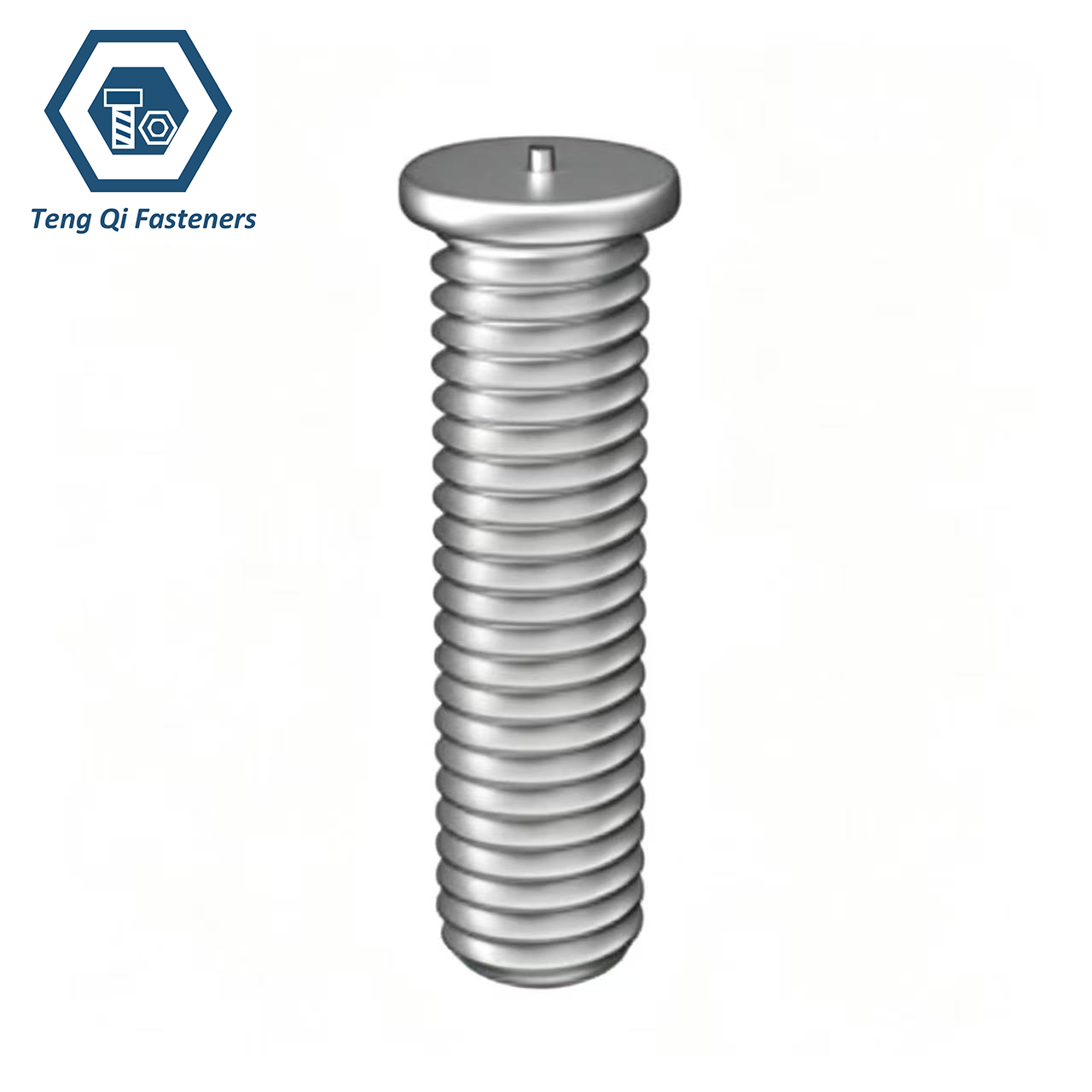
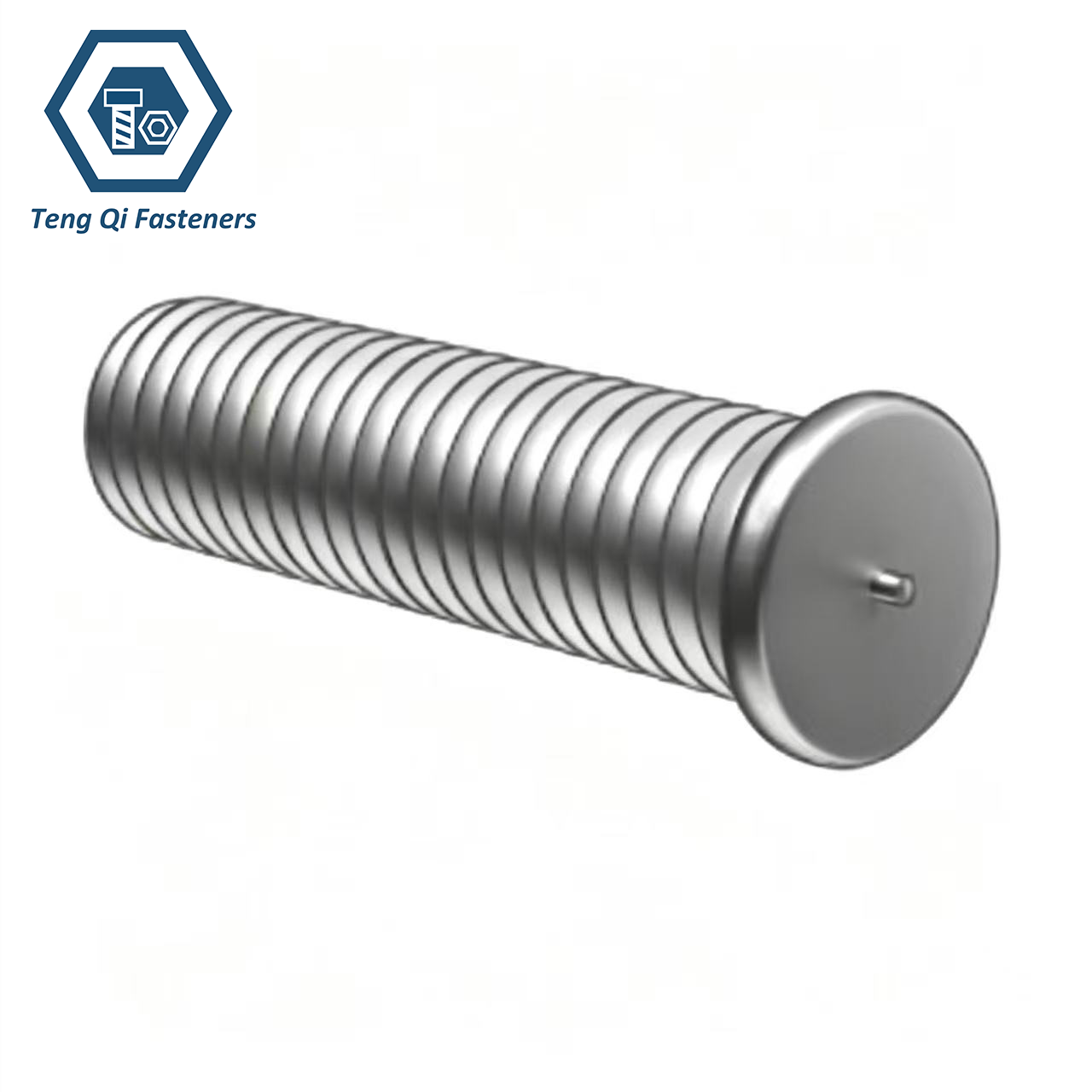
Specification:
The specification of a DIN 32501 threaded weld stud involves more than its thread size alone. The threaded section determines the component that can be attached after welding, while the stud length and welding-end geometry need to correspond to the thickness and welding conditions of the metal substrate. These parameters should be considered together when selecting a stud for a particular assembly.
The thread size and pitch are selected according to the nut or component that will be installed after welding. Overall length determines the available fastening height above the parent material, while the welding end must be compatible with the selected stud-welding process. Material selection should also take both the stud and parent material into account; carbon steel is commonly used for fabricated steel assemblies, while stainless steel is suitable where corrosion resistance is more important.
| Item | Specification |
|---|---|
| Standard | DIN32501 |
| Product Type | Threaded Weld Stud |
| Installation | Single-Point Stud Welding |
| Threaded Type | External Metric Thread |
| Thread Size | M3-M6 |
| Thread Pitch | Metric Coarse |
| Material | Carbon Steel/Stainless Steel |
| Application | Permanent Threaded Fastening Points |
| Surface Treatment | Bright Pickling,Plain,Copper Plating,Passivation |
Dimension Chart of DIN32501 Weld Studs:
The DIN 32501 dimension chart provides the key measurements needed to select a threaded weld stud for a specific assembly. In addition to the thread diameter and overall stud length, the threaded length and welding-end dimensions should be considered because they determine the available fastening height and compatibility with the selected stud-welding process.
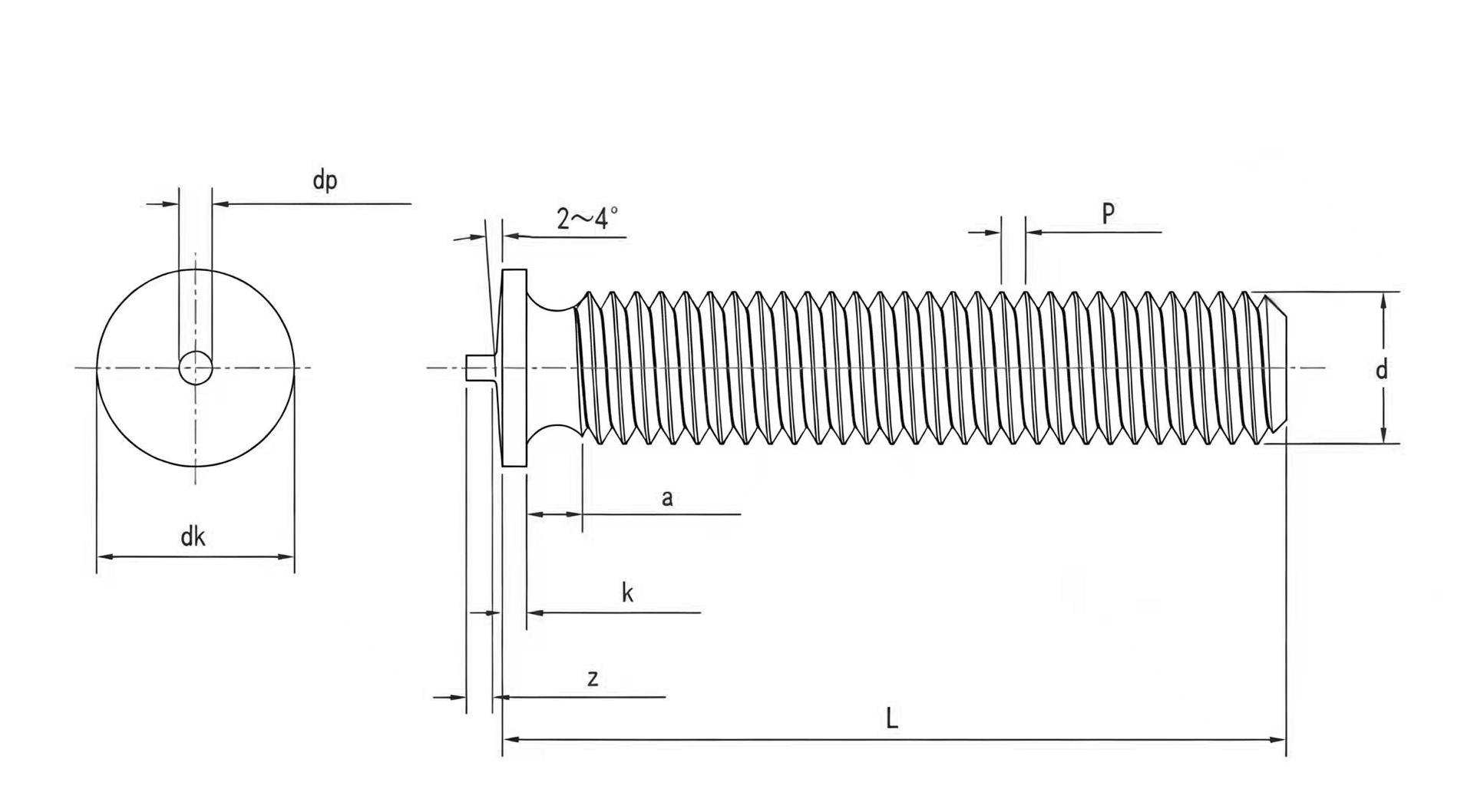
| Mon | M3 | M4 | M5 | M6 |
| P | 0.5 | 0.7 | 0.8 | 1 |
| dk max | 4.7 | 5.8 | 6.7 | 7.7 |
| dk min | 4.3 | 5.4 | 6.3 | 7.3 |
| dp max | 0.73 | 0.73 | 0.83 | 0.83 |
| dp min | 0.57 | 0.57 | 0.67 | 0.67 |
| z max | 0.6 | 0.6 | 0.6 | 0.85 |
| z min | 0.5 | 0.5 | 0.5 | 0.75 |
| k max | 1.4 | 1.4 | 1.4 | 1.4 |
| k min | 0.7 | 0.7 | 0.8 | 0.8 |
| a max | 1.5 | 1.5 | 2 | 2 |
- Stainless Steel ISO14585 Torx Pan Head Self Tapping Screws
- Stainless Steel ISO14584 Torx Raised Countersunk Head Screws
- Stainless Steel ISO14583 Hexalobular Socket Pan Head Screws
- Stainless Steel ISO14581 Stainless Steel Hexalobular Socket Countersunk Flat Head Screws
- Stainless Steel ISO14580 Hexalobular Socket Cheese Head Screws
- Stainless Steel ISO14579 Hexalobular Socket Head Cap Screws
- Stainless Steel ISO1207 Slotted Cheese Head Screws
- Stainless Steel ISO10642 Stainless Steel Socket Cap Countersunk Head Screws
- Stainless Steel DIN251 Hexagon Socket Head with Serrated Flange Screws
- Stainless Steel DIN316 Wing Screws
- Stainless Steel DIN6912 Thin Head Socket Cap Screws with Pilot Recess
- Stainless Steel DIN6928 Hexagon Washer Head Tapping Screws
- Stainless Steel DIN7500PE Torx Pan Head Thread Rolling Screws
- DIN7500EE Hexagon Cheese Head Thread Rolling Steel Screws
- DIN7505 Particle Board Countersunk Head Screws with Cross Recess
- Stainless Steel DIN7982 Cross Recessed Countersunk Head Tapping Screws
Application of DIN32501 Stainless Steel Studs for Stud Welding with Tip Ignition:
DIN 32501 Stainless Steel Studs for Stud Welding with Tip Ignition are widely used in industries that require strong, reliable, and permanent fastening solutions. With excellent corrosion resistance, and stable welding performance, these stainless steel welding studs are suitable for various applications where traditional fastening methods are difficult or inefficient.
| Application | Details |
|---|---|
| Construction Industry | Used for fixing metal components, structural elements, insulation systems, and building accessories where strong welded connections are required. |
| Automotive Industry | Applied in vehicle body assembly, exhaust systems, and other automotive components requiring lightweight and durable fastening solutions. |
| Shipbuilding and Marine Engineering | Stainless steel welding studs provide reliable connections in marine environments due to their excellent corrosion resistance. |
| Electrical and Electronic Equipment | Used for mounting brackets, grounding components, panels, and enclosures that require secure attachment. * Industrial Machinery: Suitable for equipment manufacturing, machine frames, and metal fabrication applications requiring high-strength fastening. |
| Metal Fabrication and Steel Structures | Commonly used for attaching sheets, plates, and accessories through efficient stud welding processes. |
| Energy and Chemical Industries | Stainless steel materials make these studs suitable for applications exposed to moisture, chemicals, and harsh operating conditions. |