
DIN6795 Grounding Washers
DIN 6795 Contact Washers are designed to create a reliable electrical connection between the fastener and the mating surface. Their specially formed contact surface penetrates or grips the surface coating during tightening, helping establish a stable conductive path while also increasing the washer’s grip on the joint.
The compact washer design allows it to be installed together with standard bolts, screws, and nuts without requiring significant additional space. Depending on the application, DIN 6795 Contact Washers can be supplied in carbon steel, spring steel, or stainless steel, with suitable surface finishes for electrical, mechanical, and environmental requirements. They are commonly used for grounding connections, electrical cabinets, control panels, machinery, equipment, sheet-metal assemblies, and other applications where reliable electrical contact and secure fastening are required.
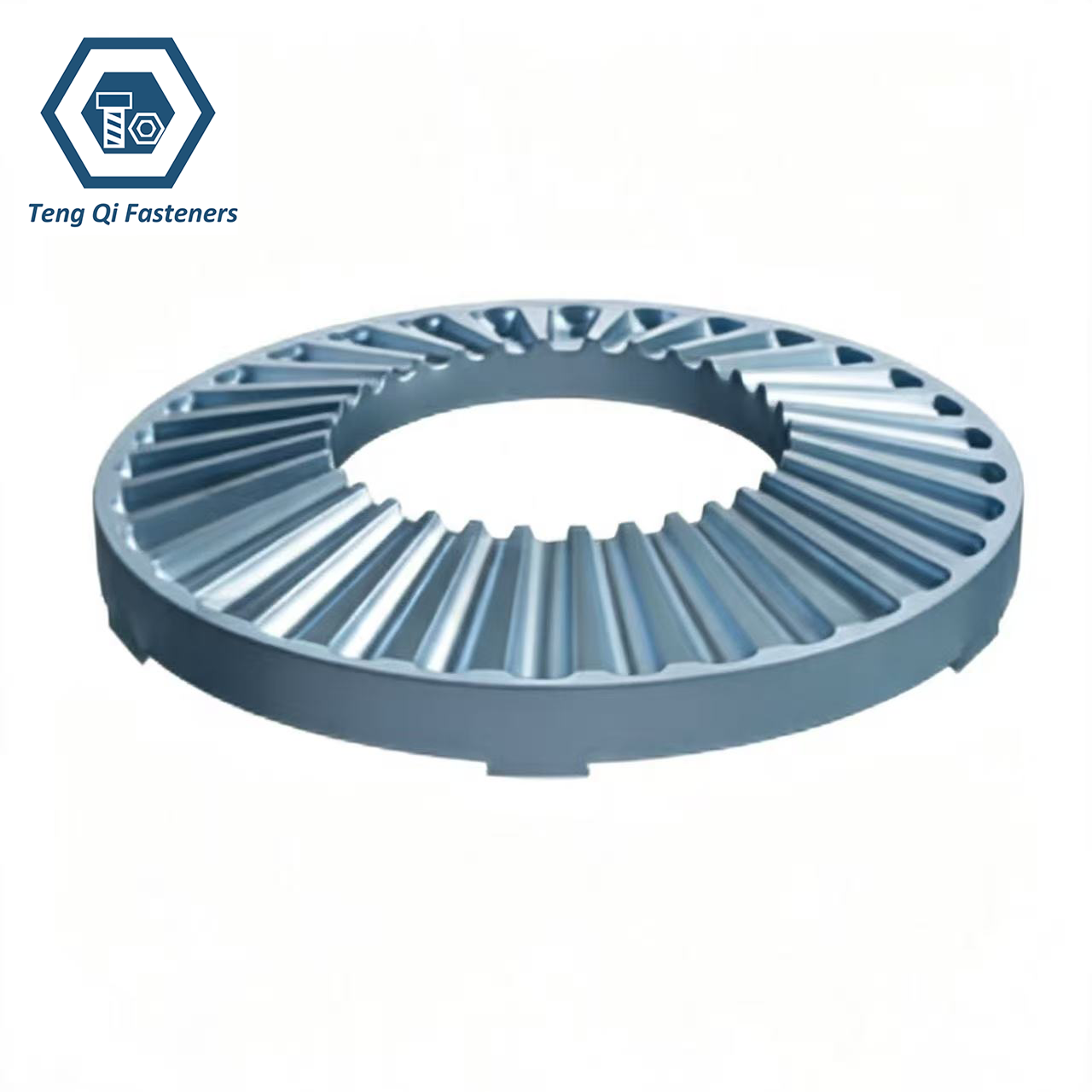
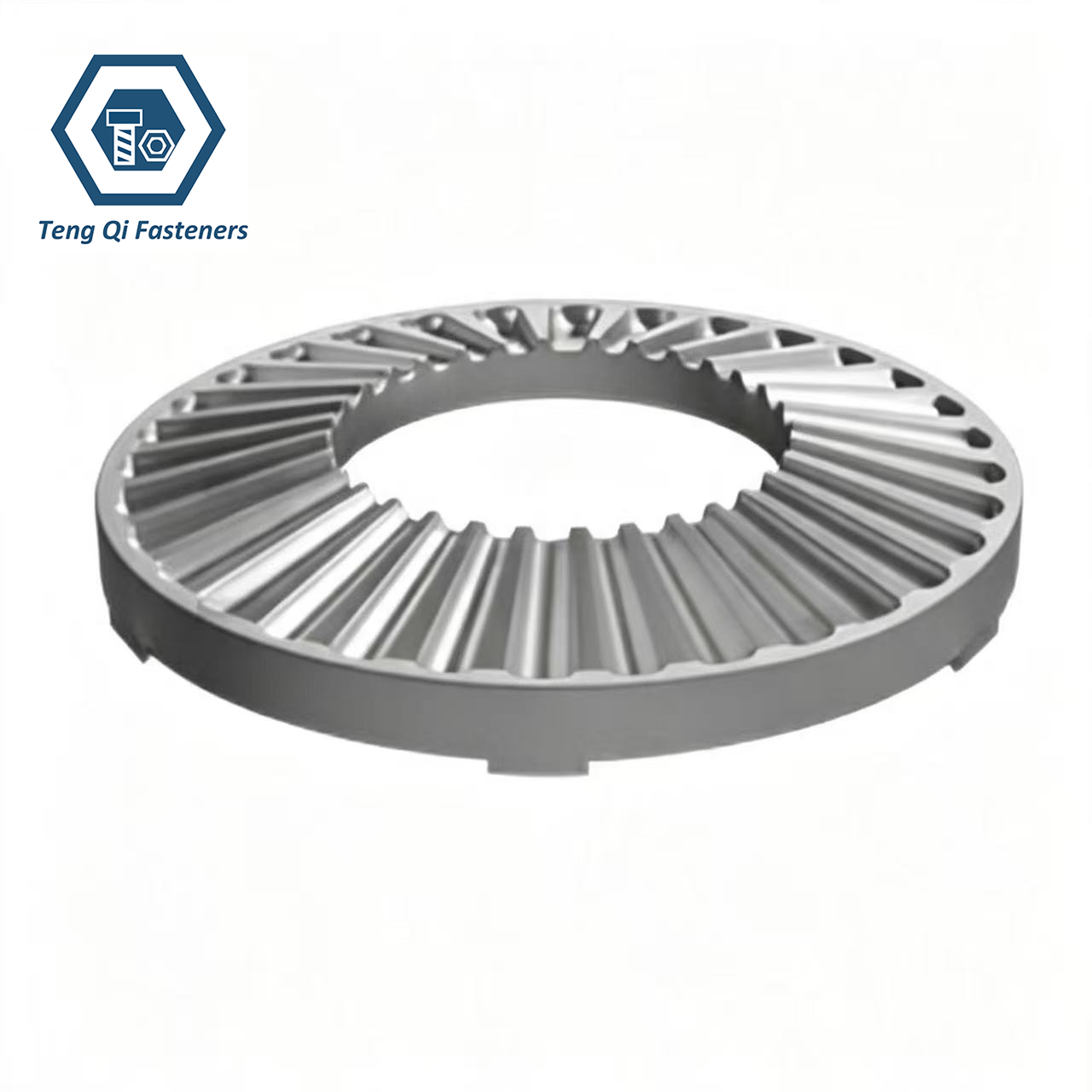
Specification:
DIN 6795 Contact Washers are manufactured with a formed contact profile that provides both mechanical grip and electrical contact between the fastener and the mating surface. Carbon steel and stainless steel options can be supplied according to the required mechanical and environmental conditions. Spring steel versions can also be used where higher hardness and stronger surface engagement are required. The washers can be supplied in different hardness levels, dimensions, and surface finishes. Carbon steel versions are available with finishes such as plain, black oxide, or zinc plating, while stainless steel versions can be supplied in A2 (304) and A4 (316) with cleaning or passivation. The material, hardness, and finish can be selected according to the substrate, fastening load, and electrical contact requirements.
| Item | Specification |
|---|---|
| Standard | DIN6795 |
| Product Type | Contact/Grounding Washer |
| Size Range | M3-M20 |
| Material | Carbon Steel,Spring Steel,Stainless Steel |
| Hardness | 42-48HRC |
| Contact Profile | Formed,Serrated |
| Surface Finish | Zinc Plated,Black Oxidation,Bright Finish,Passivation |
Dimension Chart of DIN6795 Grounding Washers:
The dimension chart provides the main measurements needed to select the correct DIN 6795 Contact Washer. Depending on the washer size, the chart covers the inner diameter, outer diameter, material thickness, overall height, and contact profile dimensions.
When selecting a washer, the inner diameter should match the fastener size, while the outer diameter and washer height should provide sufficient contact with the mating surface without interfering with surrounding components. Please refer to the chart for the exact dimensions and tolerances of each available size.
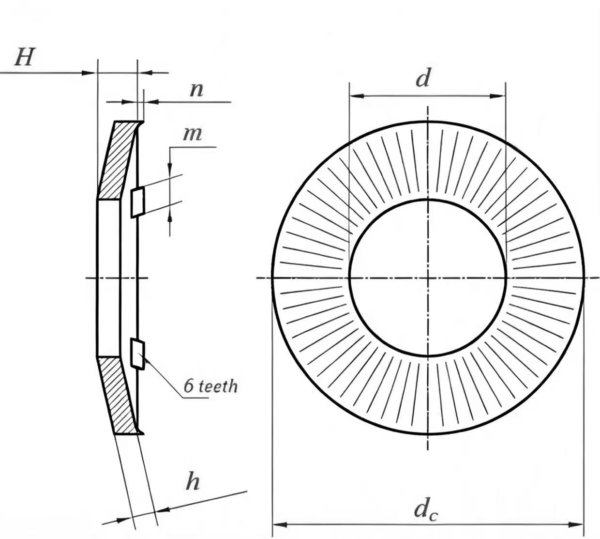
| Thread Diameter | M3 | M3.5 | M4 | M5 | M6 | M8 | M10 | M12 | M16 | M20 |
| d min | 3.1 | 3.6 | 4.1 | 5.1 | 6.1 | 8.2 | 10.2 | 12.4 | 16.4 | 20.5 |
| d max | 3.4 | 3.9 | 4.4 | 5.4 | 6.4 | 8.5 | 10.6 | 12.8 | 16.8 | 21 |
| dc min | 5.8 | 6.8 | 7.8 | 9.8 | 11.8 | 15.8 | 19.75 | 23.75 | 31.7 | 39.7 |
| dc max | 6.2 | 7.2 | 8.2 | 10.2 | 12.2 | 16.2 | 20.25 | 24.25 | 32.3 | 40.3 |
| H min | 0.8 | 0.95 | 1 | 1.25 | 1.5 | 1.95 | 2.15 | 2.15 | 3.5 | 4.2 |
| H max | 0.95 | 1.1 | 1.15 | 1.5 | 1.8 | 2.4 | 2.6 | 2.6 | 3.95 | 4.65 |
| h min | 0.57 | 0.67 | 0.77 | 0.97 | 1.16 | 1.36 | 1.56 | 1.56 | 2.42 | 2.92 |
| h max | 0.63 | 0.73 | 0.83 | 1.03 | 1.24 | 1.44 | 1.64 | 1.64 | 2.58 | 3.08 |
| m min | 0.7 | 0.9 | 1.1 | 1.9 | 2 | 2 | 2 | 2 | 4.5 | 4.5 |
| m max | 0.9 | 1.1 | 1.3 | 2.1 | 2.2 | 2.2 | 2.2 | 2.2 | 5.5 | 4.7 |
Application of DIN6795 Grounding Washers:
Grounding and Electrical Connections
DIN 6795 Contact Washers are used where a fastener must also provide a reliable electrical connection to the mating surface. The contact profile creates multiple contact points when the assembly is tightened, making the washer suitable for grounding and earthing connections.
Electrical Cabinets and Sheet-Metal Assemblies
The compact design works well with electrical cabinets, control panels, metal enclosures, switchgear, and sheet-metal components. The washer can help maintain electrical continuity between coated or treated metal surfaces and the fastening hardware.
Machinery and Equipment
DIN 6795 Contact Washers can also be used in machinery, industrial equipment, mounting assemblies, brackets, and metal structures where the connection requires both mechanical clamping and electrical contact. Material and surface treatment can be selected according to the operating environment.