
IFI 136 Double-End Stud Bolts
IFI 136 Double-End Stud Bolts are fasteners with threaded sections at both ends and a body section between them. Unlike conventional bolts, a double-end stud is installed into a tapped hole or threaded component at one end, while the opposite threaded end remains exposed for securing a mating component with a nut. This configuration provides a stable threaded connection and is well suited for assemblies where the fastener needs to remain installed in the base component.
The separate threaded ends and central body allow the stud to accommodate specific thread engagement and clearance requirements within an assembly. IFI 136 Double-End Stud Bolts are commonly used in machinery, equipment, flanged connections, engine components, and other industrial assemblies where components are secured to threaded housings or mounting parts. Standard and custom configurations are available to meet different installation and assembly requirements.
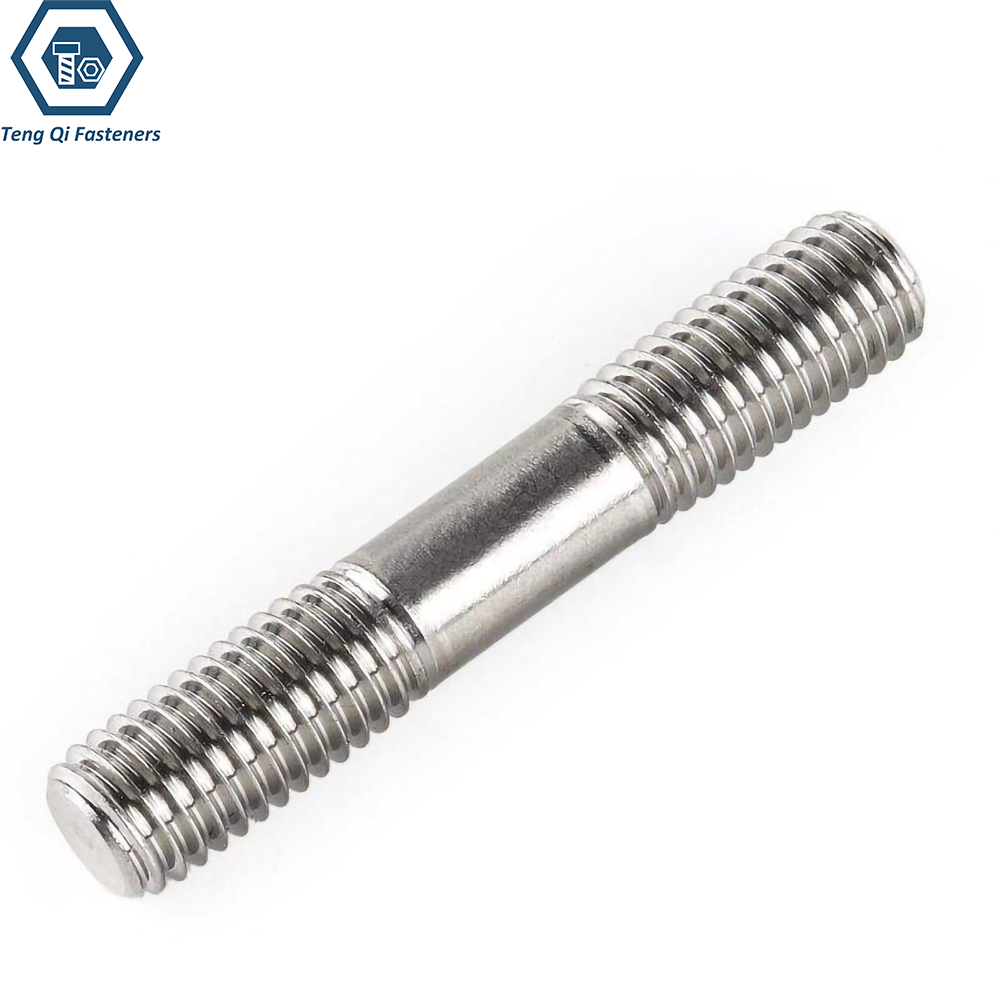
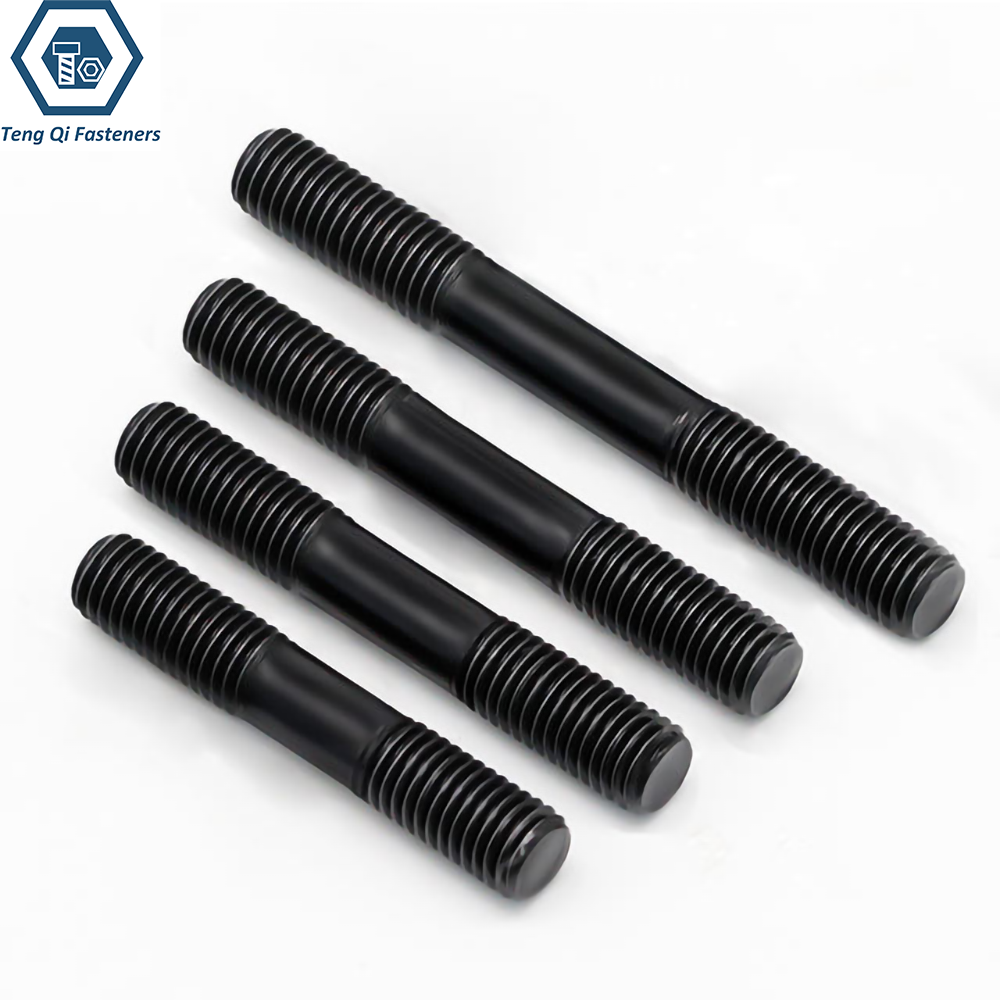
Specification:
IFI 136 Double-End Stud Bolts are inch-series fasteners with threaded sections at both ends and a central body section between the threads. The standard covers different stud configurations based on body diameter and manufacturing method, including unfinished, controlled-diameter, milled, and ground body types. Key dimensional requirements include nominal thread diameter, body diameter, thread length, and overall length, allowing the studs to be selected according to the requirements of different assemblies.
Our IFI 136 double-end stud bolts are available in carbon steel, alloy steel, and stainless steel, with UNC, UNF, and other Unified inch threads available according to application requirements. Mechanical grades and material requirements can be specified according to applicable standards such as SAE J429 for carbon and alloy steel and ASTM F593 for stainless steel. Plain, zinc-plated, black oxide, hot-dip galvanized, and other surface finishes are available, while custom stud lengths, thread lengths, body diameters, materials, grades, and finishes can be manufactured according to customer drawings and specifications.
| Item | Specification |
|---|---|
| Standard | IFI 136 |
| Product Type | IFI 136 Double-End Stud Bolts |
| System | Inch Series |
| Stud Type | Type1,Type2,Type3,Type4 |
| Thread Diameter | 1/4"-1-1/2" |
| Steel Mechanical Standard | SAE J429,ASTM A193 |
| Stainless Steel Mechanical Standard | ASTM F593 |
| Property Class | SAE GR.2,5,8 A193 B7,B8,B16 F593C,D,G,H |
| Thread | UNC,UNF |
| Thread Standard | ASME B 1.1 |
| End | Chamfered or Flat |
| Surface Treatment | Black Oxidation,Zinc Plated,HDG,Bright Finish, |
| Inspection | Dimensions, Thread,Mechanical Property,Coating |
Dimension Chart of IFI 136 Double-End Stud Bolts:
The IFI 136 dimension table covers nominal thread diameter, body diameter, minimum thread length, and other key dimensions for the different double-end stud configurations.
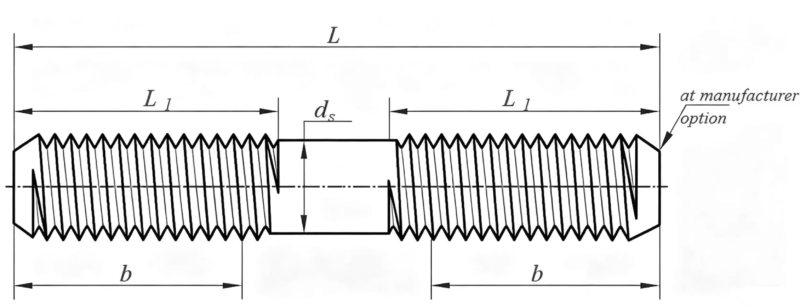
| Thread Diameter | 1/4 | 5/16 | 3/8 | 7/16 | 1/2 | 9/16 | 5/8 | 3/4 | 7/8 | 1 | 1-1/8 | 1-1/4 | 1-3/8 | 1-1/2 |
| Pitch | 20 | 18 | 16 | 14 | 13 | 12 | 11 | 10 | 9 | 8 | 7 | 7 | 6 | 6 |
| ds(max) Type2 | 0.2500 | 0.3125 | 0.3750 | 0.4375 | 0.5000 | 0.5625 | 0.6250 | 0.7500 | 0.8750 | 1.0000 | 1.1250 | 1.2500 | 1.3750 | 1.5000 |
| ds(min) Type2 | 0.2127 | 0.2712 | 0.3287 | 0.3850 | 0.4435 | 0.5016 | 0.5589 | 0.6773 | 0.7946 | 0.9100 | 1.0228 | 1.1476 | 1.2563 | 1.3812 |
| ds(max) Type3 | 0.2500 | 0.3125 | 0.3750 | 0.4375 | 0.5000 | 0.5625 | 0.6250 | 0.7500 | 0.8750 | 1.0000 | 1.1250 | 1.2500 | 1.3750 | 1.5000 |
| ds(min) Type3 | 0.2408 | 0.3026 | 0.3643 | 0.4258 | 0.4876 | 0.5495 | 0.6113 | 0.7353 | 0.8592 | 0.9830 | 1.1064 | 1.2314 | 1.3544 | 1.4794 |
| b(min)L≤6“ | 0.750 | 0.875 | 1.000 | 1.125 | 1.250 | 1.375 | 1.500 | 1.75 | 2.000 | 2.250 | 2.500 | 2.750 | 3.000 | 3.250 |
| b(min)L>6“ | 1.000 | 1.125 | 1.250 | 1.375 | 1.500 | 1.625 | 1.750 | 2.000 | 2.250 | 2.500 | 2.750 | 3.000 | 3.250 | 3.500 |
| L1(max)L≤6“ | 0.875 | 1.031 | 1.188 | 1.344 | 1.500 | 1.656 | 1.812 | 2.125 | 2.438 | 2.750 | 3.062 | 3.375 | 3.688 | 4.000 |
| L1(max)L>6“ | 1.125 | 1.281 | 1.438 | 1.594 | 1.750 | 1.906 | 2.062 | 2.375 | 2.688 | 3.000 | 3.312 | 3.625 | 3.928 | 4.250 |
- RELATED BOLTS LISTS:
- STUD BOLTS
- DIN976 STUD BOLTS
- DIN939 STUD BOLTS
- THREADED RODS
- DIN975 THREADED RODS
- ASME B 18.31.3 THREADED RODS
- FOUNDATION ANCHOR BOLTS
- DIN 529 ANCHOR BOTLS
- JIS 1178 L ANCHOR BOLTS
- JIS 1178 J ANCHOR BOLTS
- ASME B 18.31.5 J BOLTS
- ASME B 18.31.5 HOOK BOLTS
- U-BOLTS
- ASME B 18.31.5 U-BOLTS
- DIN3570 U-BOLTS
Mechanical Property of IFI 136 Stud Bolts
Stainless Steel IFI 136 Stud Bolts-F593
| Mechanical Property Marking | Diameter,in | Full-Size Tests | Machine Specimen Test | ||||
| Tensile Strength (ksi) | Yield Strength (ksi) | Rockwell Hardness | Tensile Strength (ksi) | Yield Strength (ksi) | Elongation in 4D,% | ||
| F593C | 1/4"-5/8" | 100-150 | 65 | B95-C32 | 95 | 60 | 20 |
| F593D | 3/4"-1"-1/2" | 85-140 | 45 | B80-C32 | 80 | 40 | 25 |
| F593C | 1-1/8"-1-1/4" | 100-140 | 60 | B95-C30 | 95 | 55 | 20 |
| F593D | 1-1/8"-1-1/2" | 95-130 | 45 | B90-C28 | 90 | 40 | 28 |
| F593G | 1/4"-5/8" | 100-150 | 65 | B95-C32 | 95 | 60 | 20 |
| F593H | 3/4"-1"-1/2" | 85-140 | 45 | B80-C32 | 80 | 40 | 25 |
| F593G | 1-1/8"-1-1/4" | 100-140 | 60 | B95-C30 | 95 | 55 | 20 |
| F593H | 1-1/8"-1-1/2" | 95-130 | 45 | B90-C28 | 90 | 40 | 28 |
Carbon Steel & Alloy Steel IFI Stud Bolts-SAE J 429
| GRADE | Nominal Size, inches | Full Size Proofload, psi | Yield Strength, min, psi | Tensile Strength, min, psi | Elong, min, % | RA, min, % | Core Hardness, Rockwell | Tempering Temperature, min |
|---|---|---|---|---|---|---|---|---|
| 2 | 1/4 thru 3/4 | 55000 | 57000 | 74000 | 18 | 35 | B80-B100 | N/A |
| Over 3/4 thru 1-1/2 | 33,000 | 36,000 | 60,000 | 18 | 35 | B70 to B100 | ||
| 5 | 1/4 thru 1 | 85,000 | 92,000 | 120,000 | 14 | 35 | C25 to C34 | 800F |
| Over 1 thru 1-1/2 | 74,000 | 81,000 | 105,000 | 14 | 35 | C19 to C30 | ||
| 8 | 1/4 thru 1-1/2 | 120,000 | 130,000 | 150,000 | 12 | 35 | C33 to C39 | 800F |
| Grade 2 requirements for sizes 1/4" thru 3/4" apply only to bolts 6" and shorter, and to studs of all lengths. For bolts longer than 6", Grade 1 requirements shall apply. | ||||||||
Application of IFI 136 Double-End Stud Bolts:
IFI 136 Double-End Stud Bolts are commonly used in assemblies where a threaded component needs to be securely connected to a removable part. One end of the stud is installed into a tapped hole or threaded housing, while the opposite end is used with a nut to clamp the mating component. This arrangement is particularly suitable for equipment and mechanical assemblies where the stud remains fixed in the base component while the attached part is periodically removed for inspection, servicing, or replacement.
Machinery & Equipment Assemblies
Double-end studs are widely used for machinery housings, pumps, compressors, gearboxes, engines, motors, and industrial equipment. They provide a fixed threaded connection between the equipment body and removable covers, housings, brackets, and mounting components. The stud can remain installed in the equipment housing while the external nut is removed when access to internal components is required, helping maintain consistent stud positioning during repeated assembly.
Flanges, Piping & Pressure Equipment
IFI 136 double-end studs can also be used for flanged connections, valves, pumps, pipe equipment, and pressure-related assemblies where threaded mounting points are available. The threaded end installed in the base component provides fixed engagement, while the exposed end allows the flange or other component to be clamped with a nut and washer. Stud length and thread engagement can be selected according to flange thickness, mounting-hole depth, and required clamping conditions.
Automotive, Agricultural & Industrial Applications
Double-end studs are suitable for engine components, transmission assemblies, agricultural machinery, construction equipment, machine frames, and other industrial equipment where components require secure positioning and periodic removal. Different materials and mechanical grades can be selected according to load and service conditions, while stainless steel options are available for equipment exposed to moisture, chemicals, outdoor environments, or corrosive media.