
ASME B18.6.3 Phillips Flat Head Machine Screws
ASME B18.6.3 Phillips flat head machine screws feature a flat top and a conical bearing surface designed to sit flush with the workpiece when installed in a properly countersunk hole. The Phillips drive provides convenient installation with compatible screwdrivers and power tools. Available in various sizes, thread specifications, materials, and finishes, these screws are used in machinery, electrical equipment, metal enclosures, and other assemblies where a flush head profile is required.
We supply Phillips flat head machine screws in carbon steel and stainless steel, with different material grades and surface finishes available according to customer requirements. Our manufacturing processes include cold heading and thread rolling, supported by dimensional inspection, thread gauging, and mechanical property testing as required. Products can be supplied according to the applicable requirements of ASME B18.6.3 or customer drawings, with specifications confirmed for each order.
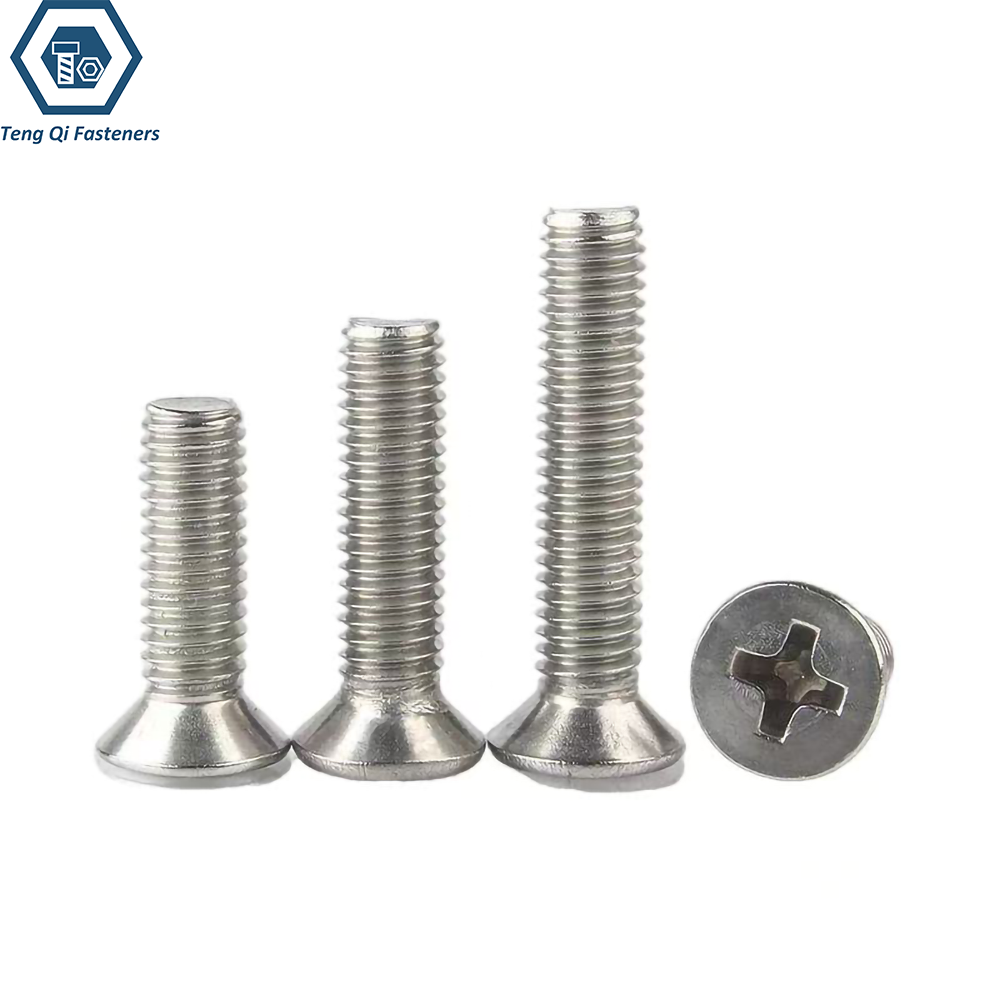
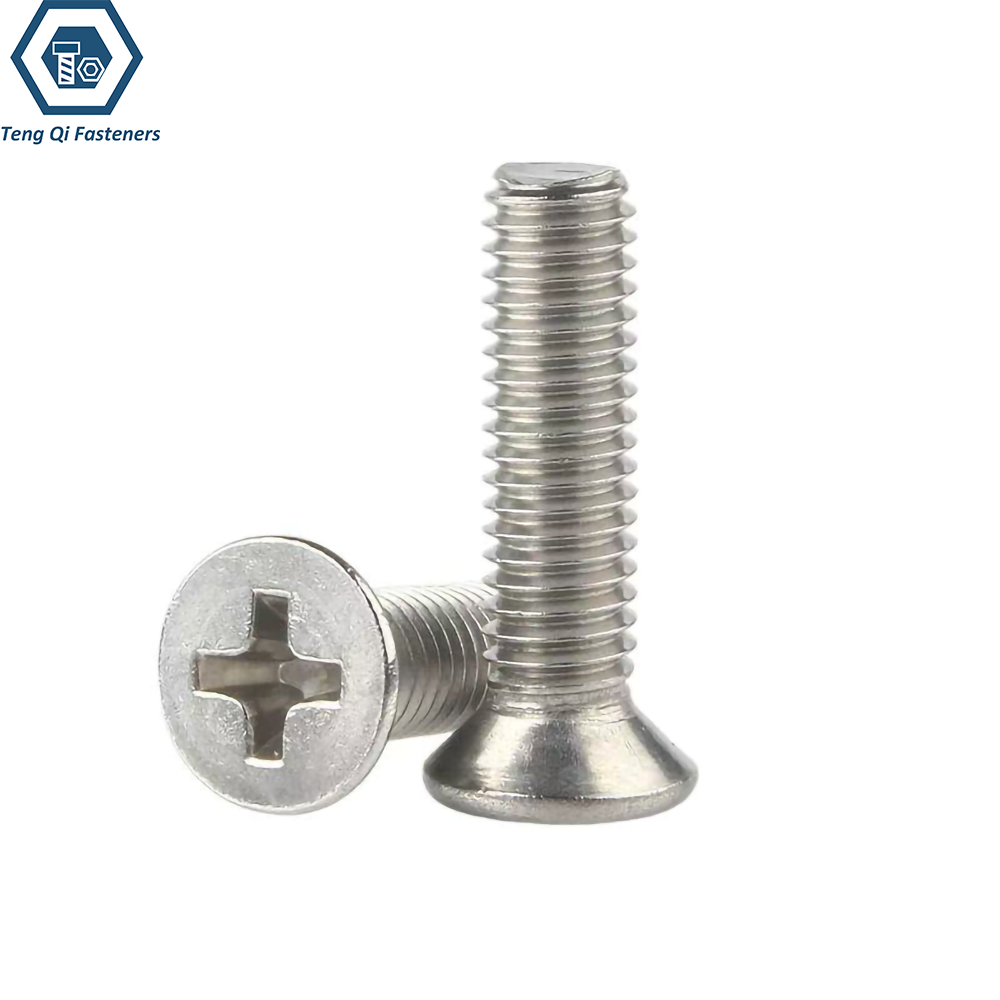
Specification:
ASME B18.6.3 Phillips flat head machine screws are available in various inch sizes and thread configurations to meet different assembly requirements. Specifications include nominal screw diameter, thread series, screw length, head dimensions, Phillips recess type, material, and surface finish. Carbon steel and stainless steel options are available, with product dimensions and mechanical requirements confirmed according to the applicable standard and customer specifications.
| Item | Specification |
|---|---|
| Standard | ASME B18.6.3 |
| Product Type | Phillips Flat Head Machine Screws |
| Head Type | Flat Head |
| Drive Type | Phillips |
| Thread System | Unified Inch Thread |
| Thread Series | UNC,UNF |
| Thread Standard | ASME B1.1 |
| Material | Carbon Steel/Stainless Steel |
| Steel Property Class | SAE J 82 |
| Stainless Steel Property Class | ASTM F837 |
| Surface Treatment | Black Oxidation,Zinc Plated,Bright Pickling,Passivation |
| Inspection | Dimensions, Thread,Mechanical Property,Coating |
Dimension Chart of ASME B18.6.3 Phillips Flat Head Machine Screws:
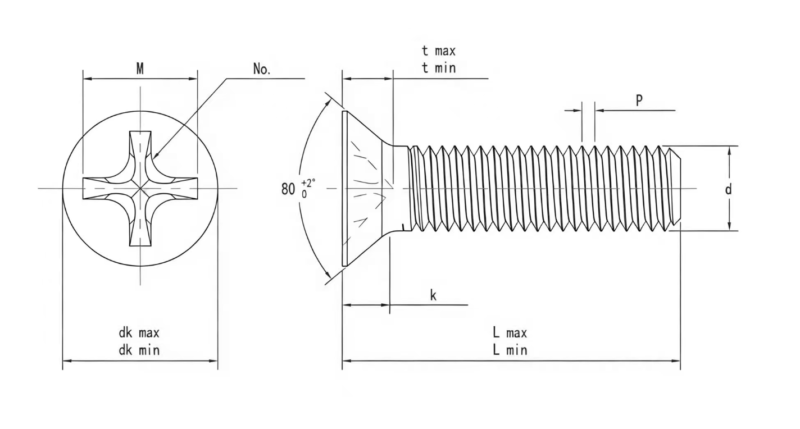
| Mon | #0 | #1 | #2 | #3 | #4 | #5 | #6 | #8 | #10 | #12 | 1/4 | 5/16 | 3/8 | 1/2 |
| P | 80 | 64 | 56 | 48 | 40 | 40 | 32 | 32 | 24 | 24 | 20 | 18 | 16 | 13 |
| dk max | 0.112 | 0.137 | 0.162 | 0.187 | 0.212 | 0.237 | 0.262 | 0.312 | 0.362 | 0.412 | 0.477 | 0.597 | 0.717 | 0.815 |
| dk min | 0.096 | 0.12 | 0.144 | 0.167 | 0.191 | 0.215 | 0.238 | 0.285 | 0.333 | 0.38 | 0.442 | 0.556 | 0.67 | 0.765 |
| No. | 0 | 0 | 1 | 1 | 1 | 2 | 2 | 2 | 2 | 3 | 3 | 4 | 4 | 4 |
| M | 0.062 | 0.07 | 0.096 | 0.1 | 0.122 | 0.148 | 0.168 | 0.182 | 0.198 | 0.262 | 0.276 | 0.358 | 0.386 | 0.418 |
| t max | 0.036 | 0.044 | 0.056 | 0.061 | 0.082 | 0.075 | 0.095 | 0.11 | 0.125 | 0.139 | 0.154 | 0.196 | 0.225 | 0.256 |
| t min | 0.02 | 0.028 | 0.04 | 0.045 | 0.066 | 0.052 | 0.072 | 0.087 | 0.102 | 0.116 | 0.131 | 0.174 | 0.203 | 0.234 |
| k | 0.035 | 0.043 | 0.051 | 0.059 | 0.067 | 0.075 | 0.083 | 0.1 | 0.116 | 0.132 | 0.153 | 0.191 | 0.23 | 0.223 |
Application of ASME B18.6.3 Phillips Flat Head Machine Screws:
Electrical Enclosures and Equipment
Phillips flat head machine screws are used to fasten covers, panels, and internal components in electrical enclosures and equipment housings. Their flat head design allows the screw head to sit flush with the surface when installed in a properly countersunk hole, providing a neat finish and minimizing interference with adjacent components.
Sheet Metal Assemblies
These screws are suitable for assembling sheet metal components with pre-tapped holes or matching threaded fasteners. They are used in metal cabinets, control panels, brackets, and fabricated assemblies where a smooth exterior surface and secure mechanical fastening are required.
Machinery and Equipment
In machinery and industrial equipment, Phillips flat head machine screws are used to secure mounting plates, protective covers, access panels, and other components. The countersunk head helps maintain a low-profile surface, particularly where protruding fastener heads could interfere with nearby parts or equipment operation.
Furniture and Metal Fixtures
Phillips flat head machine screws are also used in metal furniture, fixtures, and equipment fittings. Their flush head profile is suitable for assemblies where surface appearance, available clearance, and the positioning of adjacent components are important considerations. The appropriate screw dimensions and material should be selected acco