
DIN 7984 Low Head Socket Cap Screws
DIN 7984 Low Head Socket Cap Screws are intended for fastening points where the height available above the joint is restricted. The reduced head profile leaves more clearance around the assembly while retaining an internal hexagon drive for tightening from the exposed side.
The lower head is not simply a dimensional reduction of a standard socket head screw. The smaller head section also affects the available load capacity, which is why the current DIN 7984 specification explicitly identifies these screws as having reduced loadability. For applications where clearance is the primary limitation, DIN 7984 can be a practical alternative to a conventional high-head socket screw. Where the joint requires high preload or maximum head strength, however, the reduced load capacity should be considered during fastener selection.
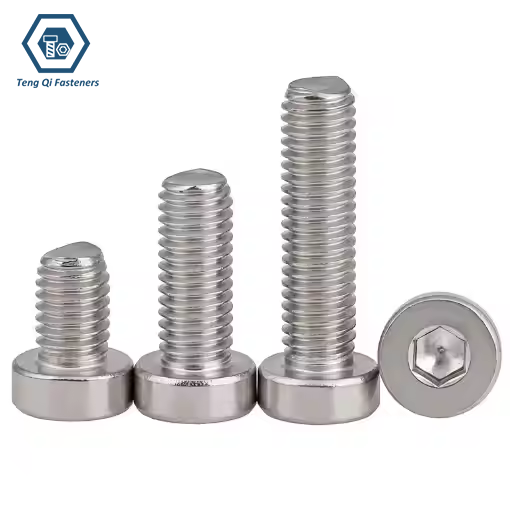
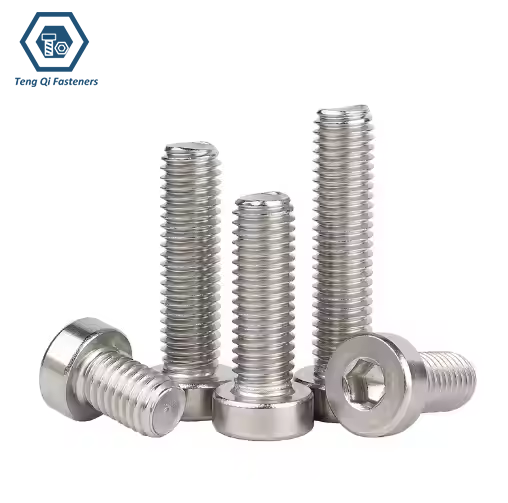
Specification:
DIN 7984 Low Head Socket Cap Screws are specified for metric threads from M3 to M24 and are manufactured to product grade A. The dimensional requirements cover the low-head geometry, shank, internal hexagon socket, thread and associated tolerances. The standard refers to the applicable ISO requirements for metric threads, mechanical properties and fastener tolerances rather than defining these requirements independently.
For steel screws, mechanical properties are specified according to DIN EN ISO 898-1, while stainless steel versions follow the applicable requirements of DIN EN ISO 3506-1. The external metric thread is normally supplied with a 6g tolerance, with thread dimensions and limits based on the ISO metric thread system. Dimensional tolerances are covered by DIN EN ISO 4759-1, product grade A. A key selection point is the reduced loadability of DIN 7984 screws. Because the head is shorter and the head/socket geometry is reduced compared with a conventional socket head cap screw, the screw head cannot necessarily withstand the same load as a standard high-head design. The 2022 edition specifically introduced this reduced-loadability designation and updated the minimum breaking-force requirements accordingly.
| Size Range | Specification |
|---|---|
| Standard | DIN7984:2022-03 |
| Product Tpye | Low Head Socket Cap Screw |
| Head Design | Low Head |
| Drive | Internal Hexagon |
| Size Range | M3-M24 |
| Thread Standard | ISO965 |
| Thread Tolerance | 6g |
| Dimension Tolerance | ISO4759-1 |
| Material | Carbon Steel,Alloy Steel,Stainless Steel |
| Property Class | 8.8,10.9,12.9 A2-70 A4-70 |
| Loadability | Reduced due to head design |
| Surface | Black Oxidation,Zinc Plated,Dacromet |
| Inspection | Dimensions,Thread,Material,Mechanical Proeperty,Coating |
Dimension Chart of DIN 7984 Low Head Socket Cap Screws:
When selecting a DIN 7984 screw, the overall length is only one part of the fit. The head diameter, reduced head height, hexagon socket size, thread pitch, and available thread length should also be checked against the surrounding component and the available installation space. Our dimension chart provides the key measurements for M3 to M24, allowing customers to compare the screw head and drive dimensions before designing the mating hole or replacing an existing fastener. For longer screws, the required minimum thread length also changes according to the overall screw length, so this should be considered when selecting the correct specification.
Selection tip: If you are replacing a DIN 912 / ISO 4762 socket head screw with DIN 7984, do not check only the thread diameter and length. The lower head and smaller hex socket change the required clearance and tool access, while the reduced head design also means that the allowable load should be considered separately.
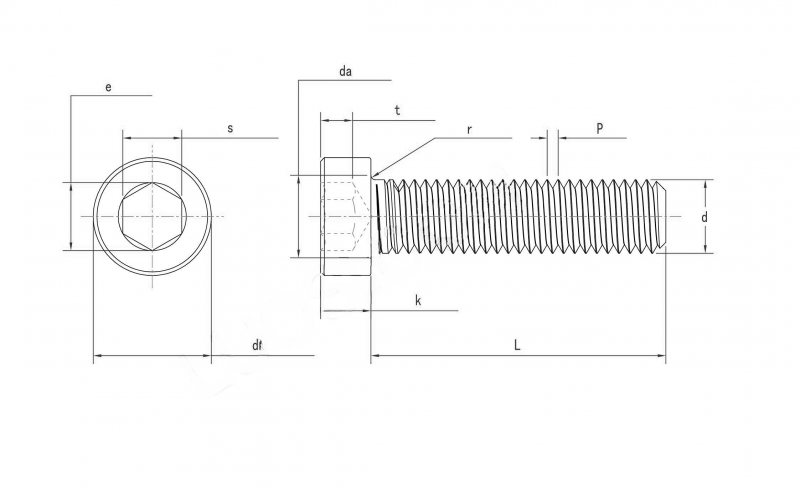
| Thread Diameter | M3 | M4 | M5 | M6 | M8 | M10 | M12 | M14 | M16 | M18 | M20 | M22 | M24 |
| P | 0.5 | 0.7 | 0.8 | 1 | 1.25 | 1.5 | 1.75 | 2 | 2 | 2.5 | 2.5 | 2.5 | 3 |
| da max | 3.6 | 4.7 | 5.7 | 6.8 | 9.2 | 11.2 | 13.7 | 15.7 | 17.7 | 20.2 | 22.4 | 24.4 | 26.4 |
| dk max | 5.5 | 7 | 8.5 | 10 | 13 | 16 | 18 | 21 | 24 | 27 | 30 | 33 | 36 |
| dk min | 5.32 | 6.78 | 8.28 | 9.78 | 12.73 | 15.73 | 17.73 | 20.67 | 23.67 | 26.67 | 29.67 | 32.61 | 35.61 |
| e min | 2.3 | 2.87 | 3.44 | 4.58 | 5.72 | 8.01 | 9.15 | 11.43 | 13.72 | 13.72 | 16 | 16 | 19.44 |
| k max | 2 | 2.8 | 3.5 | 4 | 5 | 6 | 7 | 8 | 9 | 10 | 11 | 12 | 13 |
| k min | 1.86 | 2.66 | 3.32 | 3.82 | 4.82 | 5.82 | 6.78 | 7.78 | 8.78 | 9.78 | 10.73 | 11.73 | 12.73 |
| r min | 0.1 | 0.2 | 0.2 | 0.25 | 0.4 | 0.4 | 0.6 | 0.6 | 0.6 | 0.6 | 0.8 | 0.8 | 0.8 |
| s min | 2.02 | 2.52 | 3.02 | 4.02 | 5.02 | 7.025 | 8.025 | 10.025 | 12.032 | 12.032 | 14.032 | 14.032 | 17.05 |
| s max | 2.1 | 2.6 | 3.1 | 4.12 | 5.14 | 7.175 | 8.175 | 10.175 | 12.212 | 12.212 | 14.212 | 14.212 | 17.23 |
| t max | 1.62 | 2.42 | 2.82 | 3.12 | 3.95 | 4.65 | 5.15 | 5.45 | 5.65 | 6.68 | 7.68 | 8.18 | 8.18 |
| t min | 1.38 | 2.18 | 2.58 | 2.88 | 3.65 | 4.35 | 4.85 | 5.15 | 5.35 | 6.32 | 7.32 | 7.82 | 7.82 |
Application of DIN 7984 Low Head Socket Cap Screws:
Shallow Counterbores and Restricted Head Clearance
DIN 7984 is particularly useful where a standard socket head cap screw is too tall for the available space above the joint. Its reduced head height can provide additional clearance inside shallow counterbores, recessed areas, covers, and compact assemblies.
Moving Parts and Close-Clearance Assemblies
A lower screw head can help prevent interference with sliding components, rotating parts, guides, covers, and adjacent mechanisms. Instead of changing the overall joint location to accommodate a taller screw head, the low-head design can reduce the required clearance above the fastening point.
Compact Fixtures and Machine Components
The smaller head profile is useful in jigs, fixtures, tooling, machine plates, brackets, CNC components, and compact mechanical assemblies where several fastening points are located close to other components. The internal hexagon drive still allows the screw to be tightened from above with an appropriate hex key or driver.
When Head Load Is Not the Limiting Factor
DIN 7984 should be selected primarily for its space-saving head geometry, rather than simply because it has a high material strength grade. The reduced head section affects the loadability of the screw, and the current DIN 7984 standard specifically identifies this characteristic. For highly preloaded joints or applications where maximum head capacity is critical, a conventional full-height socket head design may be more appropriate.